The interview was in March.
We had to leave before seven to reach the campus on time.
There was snow in the ditches but clear pavement on the highway.
Kaylee wore a navy sweater and black trousers.
She carried her folder in both hands.
I rode in the passenger seat.
Travis drove.
Mason was staying with Ruth for the morning.
At a rest stop, Kaylee checked her notes again.
“What if they ask why I want to do physical therapy?”
“Tell them about Grandpa,” I said.
“Everybody's going to have an inspiring story.”
“Then tell them what you actually learned.”
Travis brought back three coffees and a hot chocolate.
He handed the chocolate to Kaylee.
“Your grandpa counted every step he could take after surgery,” he said.
“You noticed which ones were harder. You asked questions about it. That's not just an inspiring story. That's how your mind works.”
She stared at him.
“That's pretty good.”
“I have a moment now and then.”
She smiled into the cup.
At the campus, we waited in a large room with other students and parents.
Some families were dressed in suits.
Some wore jeans.
A student volunteer gave Kaylee a name tag.
Then she went through a door to meet the committee.
Travis and I sat near a window.
He tapped the handle of his coffee cup.
“I'm nervous,” he admitted.
“She'll be fine.”
“I know she will.”
He looked toward the closed door.
“I'm nervous because I want her to have choices I didn't have.”
I had never heard him say that.
He explained that he had wanted to study agriculture after high school.
Glen told him college was a waste of money.
His mother was recovering from an illness.
The family needed him to work.
He went to the warehouse instead.
He liked the work.
He had built a good life.
But sometimes he wondered whether he had chosen it freely.
“Don't tell Kaylee that while she's making this decision,” I said.
“I won't.”
“She can't live the life you didn't get.”
“I know.”
He put down the cup.
“I want her to get to choose hers.”
The interview lasted half an hour.
Kaylee came out looking pale.
“I think I talked too fast.”
“Did you answer their questions?” I asked.
“I think so.”
“Then we'll have lunch,” Travis said.
She laughed nervously.
“You always say food fixes everything.”
“Not everything. Just the part where you're hungry.”
We ate at a small diner near campus.
Kaylee talked about a professor who studied rehabilitation in rural communities.
Her interest was immediate.
She had watched Grandpa drive forty minutes to appointments after his surgery.
She knew how difficult regular care could be outside a city.
On the ride home, she fell asleep with her folder on her lap.
Travis lowered the radio.
“She seems happy there,” he said.
“Yes.”
“It's farther away than I expected.”
“Yes.”
He sighed.
“I'll get used to it.”
A week later, Kaylee received a partial scholarship offer.
It wasn't enough to settle the decision.
She spread the financial-aid documents across the table.
We reviewed tuition, housing, meals, books and travel.
Travis offered to help pay what we could afford.
He did not promise an impossible amount.
He showed her the household budget.
He explained what was available from savings.
He asked her to compare costs after aid.
Kaylee listened.
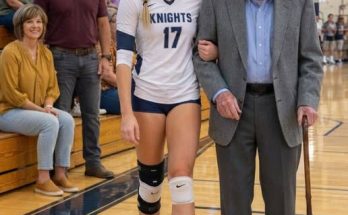
Then she said quietly, “You don't have to pay just because you feel bad about senior night.”
He looked up.
“I'm not.”
“Are you sure?”
“I started saving for your education before Mason was born.”
She blinked.
“You did?”
“We both did,” I said.
Travis nodded.
“You're part of this family. Planning for your future was never a punishment.”
Kaylee stared at the papers.
Then she reached across the table and squeezed his hand.
Neither spoke for a moment.
The financial problem was not magically solved.
We still had to make the numbers work.
But Kaylee no longer had to wonder whether helping her was an unwanted obligation.
While the scholarship committee made its decision, our household had to think carefully about what college would actually require.
Kaylee wanted a room on campus.
A commute would have been too long.
The residence hall deposit was due before the final aid package arrived.
We read the school's policy rather than guessing.
There were deadlines and refund conditions.
Travis wrote them on a calendar.
I called the financial-aid office to clarify one item.
They explained that the estimate wasn't a guaranteed bill.
Scholarship funds would be applied according to the published schedule.
Additional fees might appear after course registration.
It was not glamorous work.
But I had learned that practical care often looked like reading the fine print.
Kaylee joined every conversation.
We didn't hide the budget from her to avoid making her anxious.
We also didn't ask her to carry the entire household's worries.
One afternoon, she asked whether choosing the farther college would be selfish.
Travis sat with her at the table.
“Let's look at the difference in cost,” he said.
They compared numbers.
Then he asked which program gave her better opportunities.
Kaylee pointed to a clinical placement listed in the course catalog.
“That's why I like this one.”
“Then that belongs in the decision.”
She traced the line with her finger.
“Do you wish I'd do something cheaper?”
“I wish education didn't cost so much.”
She laughed.
“Me too.”
He looked at her.
“But I don't wish you'd want less.”
Later that week, Dad came over with an envelope.
Inside was a modest check from money he had set aside for each grandchild.
He told Kaylee he had done the same for Ruth's children.
“This isn't a prize for choosing my favorite college,” he said.
“It's just a little help getting started.”
She hugged him.
Then asked whether he wanted her to send him receipts.
“No,” he said.
“I trust you.”
I watched her face change.
She had heard that word from adults before.
But it sounded different when it wasn't followed by a demand.
That evening, Travis helped her write thank-you notes.
She addressed one to the scholarship committee.
One to Grandpa.
One to a teacher who had written a recommendation.
Travis suggested including a specific detail in each note.
“You remember what people actually did for you,” he said.
Kaylee smiled.
“Like you remember all my games?”
“Exactly.”
One evening, Kaylee became frustrated with the scholarship application portal.
It kept rejecting a document she had uploaded.
She was certain the deadline would pass before she could fix it.
Travis sat beside her at the computer.
He didn't take the mouse.
He asked what error message appeared.
Together they checked the file format and the size limit.
The school required a PDF rather than a photograph.
Kaylee scanned the document properly and tried again.
This time it uploaded.
She leaned back in her chair.
“I would've figured that out eventually.”
“Probably.”
“Thanks for helping.”
“Anytime.”
Then she asked a question that caught him off guard.
“Did you help Mom with things like this when you first got married?”
“Plenty.”
“Did she ever make you feel like it wasn't your place?”
He shook his head.
“No.”
“Then why did you think helping me was different?”
He considered that.
“Because I worried you'd think I was replacing somebody.”
She pointed to the screen.
“You didn't replace the person who designed that website. You just helped me use it.”
He laughed.
“Fair point.”
She grinned.
Then she turned back to her checklist.
The next task was a recommendation letter.
She wrote an email to her science teacher and read it aloud.
Travis suggested one correction.
She accepted it.
It was a small, ordinary evening.
But the ease between them felt new.
Click here to continue reading: PART 11: Mason Asks Who Counts as Family and Makes the Adults Face Their Careless Words
The Dinner Where Kaylee Asked Travis to Walk and Heard the Words Real Fathers Instead
Part 10 of 16