At the end of October, Kaylee's English teacher assigned an essay about belonging.
Students could write about a place, a tradition, or a person.
Kaylee chose family.
She didn't tell us at first.
I discovered the topic when she asked whether she could borrow a photograph from our wedding album.
“What for?”
“School.”
“Which one?”
“The one where Mason's barely a baby and Travis is carrying me because my shoes hurt.”
I laughed.
“That was your idea.”
“I know.”
On our wedding day, Kaylee had insisted on wearing white sneakers beneath her flower-girl dress.
She had spent the afternoon dancing.
By the end, she was exhausted.
Travis had carried her from the reception hall to the car.
She fell asleep before he reached the parking lot.
“It's in the blue album,” I said.
She took it upstairs.
The following Thursday, she asked Travis whether he would read her essay.
He looked up from the newspaper.
“Of course.”
She placed three typed pages in front of him.
“Don't correct the grammar. Mrs. Jensen already did.”
He smiled.
“Okay.”
Then he read.
The essay began with Brandon's empty seat at a school concert.
Kaylee described studying the doorway between songs, certain he would appear.
Then she described Travis arriving late from work, still wearing steel-toed boots, and squeezing into a folding chair.
He had missed her solo.
But afterward he asked to hear it at home.
He sat through the entire piece while she played it on a borrowed flute.
I remembered that night.
Travis had looked embarrassed because he didn't understand music.
He still applauded.
The essay moved through ordinary memories.
A flat tire before a tournament.
A science project built at our kitchen table.
Mason's first day of kindergarten.
Grandpa teaching Kaylee how to check a calf's breathing.
And senior night.
Kaylee wrote that the people who loved her did not all use the same names.
She also wrote that sometimes she wished adults would stop deciding which names were allowed.
Travis held the paper for a long time.
He didn't comment on her writing.
“Can I ask what part hurt most?” he said.
Kaylee sat across from him.
“When you said real fathers.”
“Because it sounded like the things I did weren't real?”
She nodded.
“Because then I wondered if I was real to you.”
He swallowed.
“You are.”
“I know that most days.”
The qualifier hung between them.
He put the essay down.
“I'm sorry I made you have days when you weren't sure.”
She looked toward me.
I stayed by the sink.
This was theirs to discuss.
“Can I keep a copy?” Travis asked.
“Sure.”
“But only if you want me to.”
“Travis.”
He paused.
“You can stop saying that every time.”
He looked startled.
Then Kaylee smiled.
“You're allowed to be in my life. You don't need permission for every little thing.”
He laughed softly.
“Okay.”
“Just don't make big decisions about me without asking.”
“That I can promise.”
For a while, they talked about her college applications.
Kaylee wanted to study physical therapy.
She had become interested after watching Grandpa work through his hip rehabilitation.
She asked whether Travis could drive her to a campus visit the following month.
He answered yes without hesitation.
Then she asked whether he would take time off work.
“I'll arrange it.”
I watched his face when he said that.
There was no fear of taking somebody else's role.
Only the practical question of who would cover his delivery shift.
That evening, I read the essay after Kaylee offered it to me.
The last paragraph described the senior-night photograph.
Kaylee wrote that Grandpa had not asked whether he deserved the walk.
He had asked what time to arrive.
She said that answer had taught her something about love.
I put the pages down.
I wanted to tell her the essay was perfect.
But she wasn't asking for praise.
She was sharing how she had understood the night.
“Thank you for letting me read it,” I said.
She leaned against my shoulder.
“Do you think Travis is different?”
“Yes.”
“Like permanently?”
“We'll have to see.”
She considered that.
“That's okay.”
When the essay was returned, Mrs. Jensen had written a note at the bottom.
Your voice is strong when you trust your own memory.
Kaylee pinned the note above her desk.
The senior-night rose had dried in a book beside it.
Kaylee's essay wasn't the only schoolwork that forced us to talk about family.
In history class, she had been assigned a short oral presentation about an older relative.
She chose Grandpa.
She visited the farm with a recorder and a notebook.
Dad was delighted to have an audience.
He described milking cows before sunrise, repairing broken equipment in winter, and raising children while the bills never seemed to shrink.
Kaylee asked what had been hardest about parenting.
Dad thought for a long time.
“Admitting when I was wrong,” he said.
She laughed.
“Really?”
“Really.”
He told her about a day he'd scolded me for losing a tool I hadn't touched.
He found it in his own coat pocket that evening.
Instead of apologizing, he bought me an ice cream.
I remembered the ice cream.
I hadn't known why he'd brought it.
“Your grandma told me that wouldn't do,” Dad said.
“She made me say the actual words.”
Kaylee wrote them in her notebook.
Later she asked whether he had ever been frightened he wasn't a good father.
“Every year,” he said.
“Even now?”
“Especially now. I know how many chances I had to do better.”
Kaylee sat with that answer.
When she played the recording for me, I heard an unfamiliar sadness in Dad's voice.
He had done many things well.
He had also made mistakes that still troubled him.
I called him afterward.
“You did enough,” I said.
“Sometimes,” he replied.
“Not always.”
I smiled sadly.
He wasn't asking for reassurance.
He was telling the truth.
At the presentation, Kaylee spoke about his fifty-one years with dairy cattle.
She spoke about his hip operation.
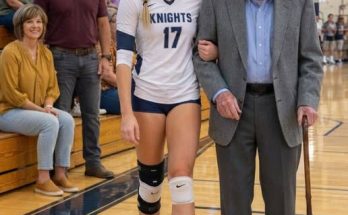
Then she showed the senior-night photograph.
Her classmates listened quietly.
She described the sound of the cane against the gym floor.
She explained that her grandfather hadn't tried to walk faster to please the crowd.
He had asked her to match his pace.
That was what she'd remembered most.
When she came home, she told Travis that the teacher gave her a high mark.
He asked if he could read the presentation.
She said yes.
He read it at the counter.
Then he said, “Your grandpa's right. Saying sorry is harder than buying ice cream.”
Kaylee laughed.
“Are you offering ice cream?”
“After I finish the dishes.”
They went together.
The English teacher invited parents to a student writing evening.
Kaylee said she would rather not read her essay aloud.
She feared classmates might turn her family into gossip.
I agreed she should decide what to share.
Then she asked whether Travis would be hurt if she kept it private.
“He knows what's in it,” I said.
“Do you think he'll understand?”
“Ask him.”
She did.
Travis told her the essay belonged to her.
She could submit it, read it aloud, or keep it in a drawer.
He would still be proud of her work.
Kaylee chose a different piece for the event.
It was about the sound of the gym before a volleyball match.
She described sneaker soles squeaking, teammates calling, and the brief silence before a serve.
Travis attended with me.
We listened as she read from the podium.
Her voice shook at first.
Then it grew stronger.
Afterward, we congratulated her in the hallway.
Travis asked about one sentence he liked.
She explained how she'd revised it three times.
They talked about writing instead of senior night.
That was important too.
Kaylee deserved to have talents and interests that weren't reduced to a family problem.
Her identity was bigger than who had walked beside her on one evening.
Click here to continue reading: PART 8: The Campus Visit That Tested Whether Travis Could Let Kaylee Choose Her Own Future
The Dinner Where Kaylee Asked Travis to Walk and Heard the Words Real Fathers Instead
Part 7 of 16