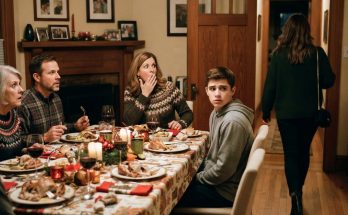
One evening, Dad and I sat on the back porch after Emma went to bed.
The night smelled of cut grass.
A moth kept circling the porch light.
Dad held a cup of tea that had gone cold.
"There's something I should tell you," he said.
I looked up.
He told me about his own first marriage, years before I was born.
I knew it had ended.
I had never asked many questions.
"I stayed too long in a house where people weren't kind to each other," he said.
"I thought working harder would make everything better."
He stared into the yard.
"I confused being dependable with never admitting something was wrong."
I waited.
"When you married David, I saw some things that worried me."
"I know."
"I told you I didn't like him. I didn't tell you why."
I remembered our arguments.
Dad had called David controlling.
I had said he was judgmental.
We had both grown quieter afterward.
"I should have asked better questions," Dad said.
Dad's story about his first marriage stayed with me for days.
I wanted to ask more but didn't want to pry.
Finally, over breakfast, I asked what helped him leave that relationship.
He put down his mug.
"A friend told me that keeping a promise shouldn't require becoming somebody I didn't recognize."
He said the separation had not been simple.
One Sunday Dad and I cooked breakfast together while Emma built a tower from plastic cups.
I asked him why he had insisted on protecting my inheritance in the first place.
He looked at the pan.
"Your grandmother wanted you to have choices," he said.
"She worried that people would see money as permission to make decisions for you."
I remembered rolling my eyes when she explained the trust.
At the time I thought she distrusted marriage.
Dad said she didn't.
She believed a good relationship could survive clear boundaries.
"You don't prove love by giving up every choice," he said.
I flipped a pancake and considered that.
When David asked me to share the account, I had felt proud of my willingness to trust.
I didn't want to become someone who trusted no one.
I just wanted trust to work alongside information and consent.
Dad brought the plates to the table.
Emma's cup tower collapsed with a loud clatter.
She stared at it, then burst into laughter.
Dad sat on the floor and helped her rebuild.
I watched them for a minute.
He never told her the collapse was her fault.
He asked how she wanted to make the next tower stronger.
That was the kind of relationship I wanted her to recognize when she grew older.
A person who helped repair a mistake without making someone afraid.
Later I called the adviser to schedule another review of my finances.
I no longer felt embarrassed to ask questions about money.
The inheritance was important.
But the ability to make informed decisions about it was becoming equally important.
There had been bills, arguments, and months of uncertainty.
He had made mistakes too.
"I wasn't always a good listener," he admitted.
"I thought every problem needed a solution immediately."
"You still do that sometimes," I said.
He laughed.
"I'm trying."
It felt good to tease him.
I had spent so long protecting David from harmless criticism that ordinary disagreement seemed dangerous.
Dad asked what I wanted our relationship to look like after I moved out.
I said I wanted Sunday dinners sometimes.
I wanted him to call before dropping by.
And I wanted him to tell me if caring for Emma became too much.
"That sounds fair," he said.
We discussed practical boundaries rather than making grand promises.
He would remain an emergency contact.
He could take Emma to her appointments when I asked.
He wouldn't call my lawyer without me knowing.
I would update him about major safety issues without giving him every private detail.
Then he mentioned a box in the attic.
It held photographs of me as a child.
We brought it downstairs after lunch.
In one picture I was standing on a bicycle with my feet barely touching the pedals.
Dad's hands hovered behind the seat.
My face looked fierce with concentration.
"I remember that day," he said.
"I fell twice."
"Three times."
I grinned.
"You counted?"
"I remember you getting back on."
I looked at the photograph for a long time.
I had learned endurance early.
I just needed to understand that endurance did not always mean staying in the same place.
Sometimes it meant riding away from something unsafe while there was still road ahead.
"I should have made it easier for you to talk without feeling I was waiting to say I told you so."
I looked at his hands.
The knuckles were thick from decades of work.
"I didn't want to disappoint you."
"You never had to earn a place here."
The sentence came too late for the girl I had been.
But it reached the woman sitting beside him.
"Can I ask you something?" I said.
"Anything."
"If I stay here longer than we planned, will you tell me when it's too much?"
He smiled sadly.
"I'll tell you what I can do and what I can't. That's better than making promises neither of us can keep."
We talked about practical things.
My return to work.
My therapy schedule.
Emma's kindergarten enrollment.
The possibility of renting a place nearby when the finances allowed.
Dad didn't offer to buy me a new life.
He offered a room while I built one.
I realized that was exactly what I wanted.
Not another person in charge.
A safe place to make decisions.
Dad and I also learned to disagree again.
He wanted to pay for a larger apartment.
I wanted to rent something I could manage myself.
He argued that Emma would benefit from extra space.
I told him my budget mattered too.
We discussed it over several dinners.
Neither of us shouted.
Neither threatened to withdraw love.
Eventually Dad said he respected my choice.
"I just worry," he admitted.
"I know."
"Sometimes I forget you're not twelve."
I laughed.
"Sometimes I feel twelve when you start making plans for me."
He looked embarrassed.
Then we laughed together.
That disagreement taught me something important.
A safe relationship could survive a no.
When Dad visited the rental for the first time, he stood in the kitchen and looked around quietly. I expected him to point out everything he would have done differently. Instead he asked where to put the groceries. I showed him the lower cupboard. He placed the bag there and admired Emma's paper animals along the hallway. She took him on a tour that lasted fifteen minutes. At the end he said the apartment felt like home. I realized he meant it. We had found a place small enough to afford and peaceful enough to grow in, and he trusted me to know the difference.
Click here to continue reading: PART 15: A Small Rental, a New Work Schedule, and the First Key That Was Only Mine
The Two Fingers I Raised While My Daughter Reached the Emergency Phone
Part 14 of 16