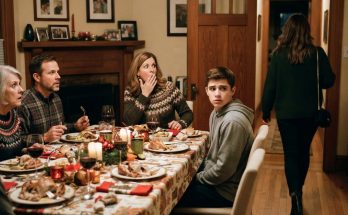
Thanksgiving arrived before the second mediation session.
Emily offered to host.
She called separately to tell Gary and me that both of us were welcome, but there would be rules.
No discussions about the lottery.
No accusations about the divorce.
No press interviews from her front porch.
No speeches to the grandchildren about loyalty.
I agreed immediately.
Gary apparently argued.
Emily told him the invitation was not a negotiation.
I was proud of her.
On Thanksgiving morning, I made two pumpkin pies.
My mother's recipe used evaporated milk and a little more cinnamon than most.
I wore an old apron and listened to the radio while they baked.
For the first time in months, the kitchen smelled like a holiday instead of coffee and anxiety.
I drove to Emily's house before noon.
The children were making place cards with colored pencils.
My granddaughter handed me one decorated with purple stars.
Grandma Patty.
I set it beside my plate and smiled.
Laura was there with her fiancé, Owen.
Nathan had driven in with his family the night before.
Gary arrived last.
He carried a grocery-store pecan pie, still in its plastic container.
He looked uncertain when he saw me.
I nodded.
He nodded back.
That was enough.
Dinner began pleasantly.
We passed the turkey and laughed when Emily's youngest spilled cranberry sauce on the tablecloth.
Then Gary asked Nathan whether he had spoken to the lawyer lately.
The room tightened.
Emily set down the gravy boat.
"Dad."
"I was only asking."
"You know the rule."
He looked around the table.
No one rescued him.
I felt a small pang of sympathy.
I knew what it was like to be corrected in front of family.
But Emily had set a reasonable boundary.
He could survive hearing it.
After dinner, Nathan and I washed dishes while the grandchildren played in the yard.
"You handled that well," he said.
"I didn't handle anything. Emily did."
"Exactly. You let her."
I handed him a plate.
"I used to think keeping peace meant smoothing every rough edge."
"Sometimes it means allowing people to manage their own feelings."
I looked at him.
"You really do turn every visit into counseling."
He laughed.
Later, Gary found me alone near the back porch.
"You look well," he said.
"Thank you."
"I've been staying at my brother's place. It's crowded."
I waited.
"I miss the house."
"I know."
"Maybe we could pause the divorce."
I turned toward him.
"Gary, we haven't finished dealing with what happened."
"That's why I'm asking."
"I'm not willing to resume the marriage."
He looked at the floorboards.
"Thirty-four years doesn't count for anything?"
"It counts for a great deal. That's why I won't pretend it can be repaired with a holiday conversation."
He didn't answer.
From the yard, we heard a child shout for a football.
Gary looked toward the sound.
"I don't want to lose the kids."
"You don't have to. Be their father. Stop asking them to settle this for you."
He nodded slowly.
For a moment I saw the man I had married at twenty-three.
The young man who could be shy around strangers and endlessly patient with children.
I wished he had given me more of that patience.
Before I left, Emily hugged me near the door.
"You sure you're okay going home alone?"
"Yes."
"You don't have to be brave all the time."
"I know."
But as I drove back through quiet streets, I felt something more peaceful than bravery.
I felt capable.
The house lights came on when I entered.
I had programmed the timer myself.
The bedroom was warm.
The pantry was stocked.
I had made plans for the weekend.
There were still unanswered questions and legal bills.
Yet I had begun to live without waiting for Gary to tell me what kind of day I was allowed to have.
The following morning, I walked to the park.
A group of older women were setting up a charity bake sale.
One asked whether I would help arrange the tables.
I said yes.
We carried trays and signs into place.
No one asked about the lottery until the sale was almost over.
When somebody recognized me from the news, I said the case was private and still being resolved.
She apologized immediately.
Then she asked whether I knew how to keep pie crust from becoming soggy.
That conversation lasted fifteen minutes.
It was the best part of my week.
When Emily asked me to help with her daughter's school project, I nearly said I was too busy.
There were settlement documents waiting on my desk.
My attorney needed a response about a vehicle valuation.
The realtor wanted another appointment.
Then I looked at the child's handwritten invitation.
Grandma, can you show us how families used to cook?
I called Emily and said I would come.
The project involved recording an older relative preparing a traditional recipe.
We made biscuits at her kitchen counter.
My granddaughter filmed with a tablet propped against a cereal box.
I explained how my mother measured flour without a scale.
The child asked why we didn't use a food processor.
"Because your great-grandmother liked washing fewer dishes," I said.
Emily laughed from the doorway.
After the biscuits baked, we ate them with jam.
My granddaughter asked whether I could come to her classroom when she presented the video.
I promised I would check my calendar.
That evening, I looked at the date.
It was the same morning as a financial planning consultation.
I moved the consultation.
The adviser had another opening.
No one was harmed by the change.
I realized how often I had treated family time as something that could only happen after everyone else's urgent demands were satisfied.
That was not what I wanted anymore.
At school, the children presented videos about dumplings, bread, stew, and birthday cakes.
My granddaughter proudly announced that her grandmother made biscuits without a recipe.
I smiled from the back row.
Afterward, she ran over and hugged me.
"Was I good?"
"Wonderful."
For an hour, I did not think about the lottery.
I did not think about lawyers.
I thought about flour on a small child's nose.
I thought about how many ordinary moments were still waiting for me.
That same week, Emily admitted she had considered asking me to take a more active role in the grandchildren's expenses.
She had stopped herself.
"I don't want you to think we only come by because of the prize," she said.
I took her hand.
"You came by before there was a prize."
"I know. But things feel different."
We discussed how money could make ordinary offers awkward.
I explained that gifts would be planned and documented, not used as substitutes for attention.
She said that sounded fair.
Then her youngest ran into the kitchen carrying a drawing of a dragon.
The conversation ended naturally.
I put the picture on the refrigerator beside the pineapple magnet.
I liked the thought that the magnet was holding something a child had given freely.
No one needed to sign a claim for that.
Click here to continue reading: PART 10: The Second Settlement Conference Turns a Jackpot Into a Real Budget
The Signature Gary Could Not Explain at the Lottery Claims Counter
Part 9 of 16