On the anniversary of the winning drawing, I drove past the highway gas station.
The morning was bright.
Mr. Ortiz had put a small handwritten sign near the register announcing a charity collection for the local food pantry.
I parked and went inside.
He recognized me immediately.
"Mrs. Dunn. Haven't seen you in a while."
"I've been busy."
He smiled.
"Good busy, I hope."
"Mostly."
I bought milk and a bag of apples.
Then I looked toward the lottery display.
The familiar tickets hung beside colorful advertisements for prizes that seemed impossibly large.
For nineteen years, I had bought one every Friday.
Two dollars from the grocery budget.
Same numbers.
Same little ceremony at the refrigerator.
I could buy another ticket.
Nothing prevented me.
But I realized I no longer wanted to.
The winning numbers had given me financial security.
They had also revealed what my marriage could not survive.
I did not need a new weekly ritual to remind me of that.
"No ticket today?" Mr. Ortiz asked.
"Not today."
He nodded and handed me my change.
Outside, I sat in the car for a moment.
There had been a time when I thought luck meant money arriving without warning.
Now I thought it might also mean having enough time to rebuild after disappointment.
I drove to Ruth's apartment and brought her the apples.
We made a pie together.
The dough stuck to the counter, and she accused me of using too much flour.
I told her she had always been bossy.
She said that was why I needed her.
We laughed until the oven timer rang.
In the afternoon, I attended a meeting at the hospital volunteer program.
They needed drivers for patients who couldn't manage public transportation after appointments.
I signed up for one morning a week.
The coordinator explained training requirements, insurance checks, and scheduling rules.
I appreciated the orderliness.
Helping people responsibly required more than a generous impulse.
After orientation, I began driving an older woman named June to physical therapy.
She was a retired school secretary who loved crossword puzzles.
On our second trip, she asked whether I had children.
I told her about Emily, Nathan, and Laura.
She asked whether I was married.
"Divorced," I said.
She nodded.
"Me too. Thirty years ago. Life keeps going."
Then she asked whether I knew the answer to a crossword clue about a bird.
I laughed.
Life did keep going.
The grandchildren grew taller.
Laura and Owen adopted a dog that chewed through two pairs of shoes.
Nathan changed schools and seemed happier with his new colleagues.
Emily began taking a pottery class.
Gary sold his interest in the troubled repair business under arrangements worked out with his advisers and lender.
I learned that from Emily, who mentioned it in passing.
I did not ask for a detailed account.
His financial life was no longer mine to manage.
Our contact remained limited and civil.
Sometimes we exchanged birthday greetings.
Sometimes we sat in the same audience at a grandchild's performance.
We did not pretend to be close friends.
We did not fight every time we met.
That balance had taken effort.
I had stopped trying to hurry it.
One evening, I found the old blue lottery notebook in a storage box.
I opened it to the first page.
Nineteen years of dates filled the lines.
Beneath the earliest entry, in my own younger handwriting, were the words I'd written on every ticket.
What is mine will never be taken from me without a fight.
I read them slowly.
The sentence had been born from a small fear that Gary would take things without asking.
I had made it into a joke.
A household superstition.
A promise to myself that I barely understood.
The signature had helped establish the trail of the winning ticket.
It had not settled the divorce by itself.
Lawyers, records, court orders, claim procedures, and difficult negotiations had done the rest.
I closed the notebook.
Then I placed it in the same keepsake box as my mother's recipes and the children's childhood photographs.
I did not need to look at it every day.
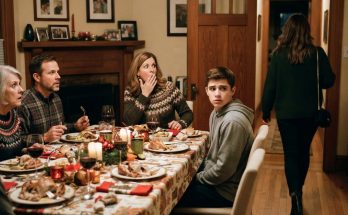
On Sunday, the children came for dinner.
We crowded around my small table with extra folding chairs.
Emily brought salad.
Nathan brought bread.
Laura brought a pie that was too sweet.
The grandchildren argued about who got the last roll.
I watched their faces and felt an old, familiar warmth.
The family had changed.
It had not disappeared.
After everyone left, I stood at the kitchen counter washing the final dishes.
There was a little tomato plant on the windowsill.
Beside it hung the pineapple magnet.
No ticket beneath it.
No secret fortune waiting to be claimed.
Just a magnet holding a drawing from my youngest grandchild.
In the picture, I stood in front of a yellow house beside three tall flowers.
The child had written GRANDMA'S HAPPY HOME across the top.
I dried my hands and touched the paper's crooked edge.
For thirty-four years, I had believed that keeping my marriage together meant keeping my life together.
I had been wrong about that.
I did not need to punish Gary to prove it.
I did not need every dollar of the lottery prize to prove it either.
I had needed honesty, a fair process, and the courage to choose a different future.
I turned off the kitchen light.
Tomorrow I would drive June to therapy.
Tuesday I would have lunch with Ruth.
Friday I might go back to the coast for a day.
I had plans of my own.
And for the first time in a very long while, that was more than enough.
A few weeks after that Sunday dinner, I held a small family gathering to celebrate Ruth's birthday.
We made her favorite lemon cake.
The grandchildren decorated paper crowns and insisted she wear one.
She wore it for exactly three photographs before declaring herself retired from royalty.
Everyone laughed.
During the meal, Emily asked whether I'd ever consider buying a house again.
I looked toward the patio.
"Perhaps a small one someday. For now, I like this place."
Nathan asked about the volunteer program.
I told him June had completed another month of therapy and was delighted about walking to her mailbox without help.
Laura described a difficult week at work.
We listened without trying to solve it for her.
No one mentioned the lottery.
No one asked Gary's whereabouts.
For an evening, our family was simply a group of people sharing food.
After they left, Ruth stayed behind to help fold the tablecloth.
She watched me carrying plates into the kitchen.
"You look different," she said.
"Older?"
"Not that. Less worried about whether everyone approves of you."
I set down the plates.
"I suppose I am."
She smiled.
"Mom would have liked that."
I opened the drawer containing the blue notebook.
I thought of nineteen years of careful signatures.
The phrase had been useful evidence when someone tried to speak for me.
But it had never been a guarantee against betrayal.
The work of protecting myself had involved learning to ask questions, accepting legal advice, making budgets, and deciding what kind of future I wanted.
I closed the drawer.
Ruth called from the living room to ask whether I wanted the leftover cake.
"Absolutely," I replied.
Some decisions were delightfully easy.
A year later, I looked at the folder where I'd kept the original claim correspondence.
The papers were still important.
They documented what had happened and how the matter was resolved.
But I no longer opened them to reassure myself that I had been right.
I knew what Gary had done.
I knew what the legal process had established.
I knew what I had chosen afterward.
I placed the folder in secure storage with the rest of my permanent records.
Then I walked to the patio and checked the tomato plants.
One was ready for picking.
I carried the fruit inside and sliced it for lunch.
It tasted like summer.
I realized I had gone an entire morning without thinking about the winning ticket.
That felt like its own quiet kind of freedom.
THE END
The End
Read more original stories on Feel Every Story.
The Signature Gary Could Not Explain at the Lottery Claims Counter
Part 16 of 16