Ana Clara opened her eyes on a Tuesday morning.
I was not there when it happened.
I was standing in a pharmacy queue buying the moisturizing cream the nurses had recommended for her dry skin.
My phone rang.
The intensive care nurse asked whether I could return to the ward.
“Is something wrong?” I asked.
“Please don't panic. The doctor would like to speak to you.”
I abandoned the cream on a shelf and went upstairs.
My heartbeat seemed louder than the elevator machinery.
At the entrance to the unit, Dr. Rocha was waiting.
“She has opened her eyes and briefly followed a simple command,” she said.
I felt the wall move under my hand.
“Can she talk?”
“Not yet. She still needs respiratory support, and her recovery will take careful assessment.”
“Does she know where she is?”
“We don't know how much she understands consistently.”
The doctor led me into the room.
Ana Clara's eyes were partly open.
She looked toward the ceiling.
Then slowly, as I approached, her gaze shifted.
“Ana?”
Her eyes stopped on my face.
I had imagined this moment a thousand times.
In every version, she smiled and said my name.
In reality, she looked frightened.
Her fingers moved restlessly against the sheet.
A nurse spoke in a soft voice.
“Ana Clara, you're in a hospital. You've been in an accident. We're taking care of you.”
I moved closer.
“It's Marcos. You're safe here.”
She looked toward the breathing equipment.
I could see her trying to understand what it meant.
“Don't try to speak,” I told her. “The doctors will explain everything.”
Her eyes filled with tears.
I wanted to hold her tightly.
The nurse showed me where I could rest my hand without disturbing the lines.
I touched her arm.
“You're not alone.”
She closed her eyes again after a few minutes.
I stood there until the doctor reminded me that rest was important.
Outside, I called Beatriz.
“She's awake,” I said.
My mother-in-law began to cry.
Then she asked whether Ana Clara had recognized me.
“I think so.”
It was the only honest answer.
Over the following days, Ana Clara became more responsive.
Some mornings she followed simple instructions.
Other times she seemed confused and exhausted.
The doctors discussed brain injury, sedation effects, and the possibility of rehabilitation.
They did not call her recovered.
Neither did I.
But the room no longer felt like a place where I spoke into silence.
One afternoon, the nurse gave Ana Clara a board with pictures and simple words.
She could indicate discomfort, thirst, or a need for help.
At first she pointed without clear purpose.
Then she began using it more reliably.
The first choice she made that I understood was *cold*.
I laughed, then cried.
Ana Clara had spent our entire marriage complaining that I liked the apartment too cold.
The nurse adjusted the blanket and checked her temperature.
“Still making your preferences known,” I whispered.
Ana Clara blinked slowly.
A week later, she was breathing with less assistance.
The team prepared for another stage of care.
They explained each step before changing anything.
I stayed nearby but let them work.
During one visit, she mouthed a word without sound.
I leaned closer.
“Again?”
Her lips moved.
I guessed wrong twice.
Then a nurse helped her point at the communication board.
Baby.*
My throat tightened.
“Miguel is alive,” I told her. “He's in the neonatal unit. He's getting stronger.”
Her face changed.
Tears ran toward her ears.
I showed her a photograph taken with the care team's permission.
In it, Miguel lay inside his incubator with one hand beside his cheek.
Ana Clara stared at the picture.
Then she touched it with one finger.
I told her his weight.
I explained the breathing equipment.
I told her the doctors were encouraged by some of his progress but that he still needed special care.
I did not say he would be home soon.
Her eyes stayed on the photograph.
That evening, Helena called me with news about the accident.
The traffic investigators had reconstructed the road conditions and examined the available camera footage.
Ana Clara's car had lost traction during heavy rain.
A delivery van had been nearby, but evidence did not show it striking her vehicle.
The van's driver had stopped farther ahead and called emergency services.
“So Gustavo wasn't involved?” I asked.
“There is no evidence linking him to the collision,” Helena said.
The words brought relief and shame together.
I had spent days imagining my brother-in-law near the road.
His financial dishonesty made the worst possibilities feel reasonable.
But the collision appeared to be an accident.
I thanked Helena for telling me clearly.
“What about the hospital?”
“That investigation is ongoing,” she said. “We've obtained records and interviewed several staff members.”
“Was it one mistake?”
“We're identifying a sequence of failures. I can't give you conclusions before the expert reviews are complete.”
She explained that the hospital had used an incorrect patient status during an overloaded shift and that a mismatch between systems had not been caught.
The account was preliminary.
People still had to explain why basic checks were missed and who authorized the transfer.
“Someone should have noticed,” I said.
“Yes,” she answered. “That is one of the central questions.”
I asked about Gustavo's interview.
Helena would not repeat private testimony.
She did tell me that the financial allegations were being examined separately.
I respected the limit, though it frustrated me.
That night, Beatriz sat beside Ana Clara with the childhood book.
For the first time, my wife looked toward the familiar cover and smiled faintly.
Beatriz began reading.
She stopped at a paragraph about a storm approaching the coast.
“I always hated this part,” she said.
Ana Clara gave a small movement of her head.
Her mother leaned closer.
“You used to say the girl should have stayed home.”
Ana Clara's lips moved.
It took several tries, but we understood her.
“Then no story.”
Beatriz laughed through tears.
It was a fragile, breathy phrase.
It left Ana Clara tired.
But it was hers.
I went downstairs to Miguel and told him his mother had spoken.
I described her eyes and her stubborn expression.
Then I told him she would want to know everything about him.
“You'd better prepare,” I whispered. “She asks a lot of questions.”
The nurse had recently shown me how to hold him for a brief skin-to-skin session when his condition allowed.
He lay against my chest, warm and light.
I could hear the monitor behind me.
My shirt smelled faintly of hospital laundry detergent.
For a few minutes, I thought about nothing except keeping still.
Then Miguel shifted his head against my skin.
I closed my eyes.
There were days ahead that would be hard.
There were investigations, bills, and questions Ana Clara would eventually need to hear.
But in that moment, my son was resting on his father's chest.
My wife had opened her eyes.
I let myself feel grateful without pretending the ordeal was over.
The next morning, Ana Clara asked for a mirror.
The nurse warned her that her face was still bruised and that she might find the changes upsetting.
Ana pointed to the picture on the communication board again.
Mirror.*
I held a small one where she could see.
She studied her reflection for a long time.
Her hair had been washed and gently brushed, but a section near her temple had been trimmed for treatment.
A faint mark remained beside her eyebrow.
She touched the scar with one finger.
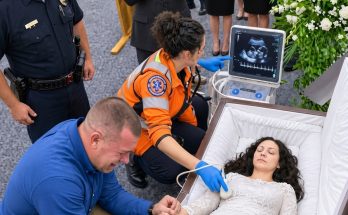
I remembered the coffin.
The memory struck me so suddenly that I had to look away.
Ana saw my expression.
“What?” she whispered.
I shook my head.
“Something difficult happened. We can talk about it when you're stronger.”
She frowned.
I knew that frown.
It was the same one she'd worn whenever I tried to hide a broken appliance or an unpaid parking ticket.
“Marcos.”
Her voice was weak.
“Tell.”
The doctor had advised us to avoid overwhelming her with traumatic details in one conversation.
I asked Ana whether she'd like the physician to explain the situation with me present.
She nodded.
Dr. Rocha joined us that afternoon.
She began with the collision and the seriousness of Ana Clara's injuries.
Then she described the error in the first hospital's records and the emergency transfer back to medical care.
She did not use the word *miracle*.
Ana Clara listened with her eyes fixed on the doctor.
When she heard she had been taken to a funeral home, her breathing became faster.
The nurse checked her and helped her settle.
“We can stop,” I said.
Ana shook her head.
The doctor gave her time.
Finally Ana managed a whisper.
“Coffin?”
I nodded.
Her eyes filled again.
I told her I had asked to see her once more and noticed movement.
I explained that paramedics had insisted on proper checks and brought her to hospital care.
She gripped the sheet.
After a while, she looked toward me.
“You?”
“I'm okay.”
She stared at me.
I corrected myself.
“I'm frightened. But I'm here.”
That seemed to satisfy her more than the first answer.
Later, a psychologist from the hospital visited.
She explained that confusion, distress, anger, and nightmares could follow critical illness and frightening information.
She offered to return when Ana felt ready.
My wife nodded.
After the psychologist left, Ana Clara asked for the baby photograph again.
I held it close.
She traced Miguel's hand with her eyes.
“Small,” she whispered.
“Very.”
“Strong?”
“He's working hard, and the doctors are helping.”
Ana looked at me.
“Don't promise.”
I understood.
She had always preferred an uncomfortable truth to a comforting lie.
“I won't,” I said.
I told her about the morning weight checks, the feeding tube, and the day he'd gripped my fingertip.
I described the way the nurse called him *Senhor Miguel* when he protested during care.
A faint smile appeared.
I showed her the small white cloud blanket.
She touched the corner.
For a moment, the room was quiet.
Then she whispered something I had to lean closer to hear.
“Gustavo?”
My stomach tightened.
“He's been asking about you.”
Ana Clara closed her eyes.
When she opened them again, she looked directly at me.
“Documents.”
I felt a chill.
“Do you remember the guarantee?”
She nodded once.
“Not mine.”
“I know. Luciana is helping us.”
She squeezed my hand.
“Don't let him.”
I wanted to ask a hundred questions.
Instead, I remembered the doctor's advice.
“You don't have to solve anything today,” I told her. “We have copies. We're protecting our home.”
She seemed to relax.
The nurse reminded me that she needed rest.
Before I left, Ana Clara whispered my name once more.
“Yes?”
“Thank you.”
I shook my head.
“You don't have to thank me.”
Her eyes stayed on mine.
I knew what she meant.
She was thanking me for asking one last time at the coffin.
I couldn't bear the idea that she might believe she owed me her life.
So I said the only thing that felt right.
“Come home,” I whispered. “When you're ready, come home.”
She did not answer.
She was exhausted from the effort of speaking.
But as I stepped toward the door, she lifted two fingers from the sheet.
It was the small wave she always gave me from the apartment balcony.
I waved back.
Click here to continue reading: PART 7: Ana Clara Met Her Son and Finally Told Investigators What Her Brother Had Done
The Heartbeat at the Crematorium Sent Us Racing Back Toward a Terrifying Uncertain Hope
Part 6 of 12