A year after the accident, we returned to the Vila Alpina Crematorium.
We did not go inside.
Ana Clara asked me to stop across the street.
Sunlight fell on the steps where Beatriz had stood in the rain.
I parked the car.
Miguel slept in his seat behind us.
Ana watched the building for several minutes.
“Are you okay?” I asked.
She nodded, then shook her head.
“Both.”
I waited.
She had suggested the visit during a counseling session weeks earlier.
Her therapist had helped her plan it carefully, without treating the place as something she had to confront to prove herself.
She could leave whenever she wanted.
Today, she'd chosen to come.
“I used to think about being in there every night,” she said. “I imagined opening my eyes and seeing the lid.”
I took her hand.
“You don't remember being there.”
“I know. My mind made a picture anyway.”
She looked toward the windows.
“I wanted to see the real place. From outside.”
We sat quietly.
The building did not look like a nightmare in daylight.
It looked like a place where grieving families came to say goodbye.
Ana exhaled slowly.
“Let's go home,” she said.
I started the car.
We didn't need to walk through the doors.
We had already done what she wanted.
The year had brought answers, though not all of them were satisfying.
The hospital's documented review had confirmed serious failures in identification, reassessment, and authorization of the transfer.
Regulatory proceedings had resulted in professional and institutional measures under the applicable rules.
Luciana continued following the compliance documentation and the expert opinions.
Our civil claim eventually reached a negotiated settlement after months of disclosure and discussion.
It provided compensation for documented additional harm and ongoing rehabilitation needs, along with written acknowledgments and specified commitments to patient-safety oversight.
The terms had been examined by our lawyers.
They did not erase what happened.
They did give us resources for care and a clearer record of responsibility.
Ana decided that most of the money should remain reserved for her treatment and Miguel's future needs.
We did not buy a larger apartment or a new car.
We paid for recommended therapy and kept an emergency fund.
We also arranged independent financial advice so the settlement would not become another source of pressure from relatives.
Gustavo's case had taken its own course.
He faced legal consequences for the unauthorized loan submission and related financial misconduct.
Under the resolution reached through the appropriate process, he was required to comply with financial obligations and supervision conditions.
The details were not the dramatic public punishment some acquaintances imagined.
He did not disappear into prison overnight.
The evidence was examined.
His lawyer spoke for him.
The court considered the applicable law and the facts.
Ana followed the proceedings through Luciana and attended only when necessary.
She was relieved when the lender's claim against her was fully resolved.
She was less interested in hearing strangers condemn her brother.
“He knew better,” she said. “I don't need an audience to tell me that.”
Beatriz continued seeing Gustavo occasionally.
She no longer paid his bills or signed his documents.
Their relationship had changed.
Some meetings were difficult.
Others were surprisingly ordinary.
She told him about Miguel's progress without sharing private photographs or details against our wishes.
She stopped carrying apologies between him and Ana.
That boundary made their conversations easier, though neither would have described them as simple.
Ana Clara did not resume contact with Gustavo that year.
He sent one handwritten apology through Luciana.
Ana read it and placed it in a drawer.
She did not answer.
When I asked whether she might someday, she considered the question.
“Maybe,” she said. “But I won't make a promise to help him feel better.”
I understood.
Some relationships could remain unfinished without ruining the rest of our lives.
Ana's recovery was also unfinished.
She still had occasional headaches and needed to plan around fatigue.
She attended periodic neurological and rehabilitation appointments.
Her psychologist helped her manage the memories and fears connected to the hospital error.
She had resumed work with adjustments, but her schedule was different from before.
Some days she missed the person who could do everything quickly.
On those days, I reminded her of the things she still did.
She corrected me when I tried too hard.
“I know what I can do,” she'd say. “Sometimes I just need to be sad about what changed.”
I was learning to let sadness exist without trying to repair it immediately.
Miguel turned one during that spring.
Because he had been born prematurely, his doctors still used corrected age for some developmental assessments.
They were pleased with much of his progress and continued monitoring areas where he needed support.
He had a serious expression when he examined new toys.
He laughed easily at the dog downstairs.
He loved pulling books from the bottom shelf.
His favorite game was dropping a spoon and waiting for me to retrieve it.
Ana called it his first experiment in cause and effect.
I called it an attack on my knees.
For his birthday, we invited only a few people.
Beatriz baked a cake.
Paulo brought a small wooden bird he'd carved himself.
Júlia brought a soft book with bright pages.
We put photographs from Miguel's first year along the wall.
There were pictures from the neonatal unit and the first day home.
There was the first family photograph taken beside the incubator.
There was a picture of Ana and Miguel laughing on the balcony.
We didn't hide the hospital photographs.
They belonged to his story.
But we didn't make them the whole story either.
When everyone gathered around the cake, Ana held Miguel on her lap.
Beatriz began singing before the candles were lit.
We all laughed.
Miguel reached for the colorful icing.
I caught his hand just in time.
Ana looked at me.
“You'll have to be faster than that when he starts running.”
“I'm training.”
She smiled.
The afternoon passed without arguments, public speeches, or surprise revelations.
It was exactly the celebration we'd wanted.
After the guests left, I found Ana sitting alone in the nursery.
She had the yellow notebook open on her lap.
“Everything okay?” I asked.
She nodded.
“I'm reading the letter I wrote before he was born.”
I sat beside her.
She turned to the page she'd never shown me.
It began with a greeting to Miguel.
Then she wrote about the life she hoped he would have.
She wanted him to be curious.
She wanted him to know he could ask difficult questions.
She wanted him to understand that making a mistake was not the same as being a mistake.
Most of all, she wanted him to feel safe enough to tell the truth.
I listened as she read.
Then she reached the last lines.
We won't always know the right answer. But we'll listen, and we'll keep learning, and we'll try again when we get something wrong.*
Her voice trembled.
“I wrote that before any of this,” she said.
I looked at Miguel sleeping in his crib.
“It's still true.”
Ana closed the notebook.
She rested her head against mine.
Outside, rain began tapping against the balcony glass.
For a moment we both listened.
A year earlier, rain had meant the sound of tires sliding, a hospital telephone call, and a future torn away.
Now it was rain outside our home.
It could still frighten us.
It no longer owned every moment.
The following weekend, Ana suggested we take Miguel to the coast.
It would be a short trip, with his pediatrician's advice and enough stops for feeding and rest.
Ana asked to drive the first stretch.
Her medical team had cleared her to resume driving after appropriate assessment and practice.
She had already managed quiet streets near our apartment.
The highway still frightened her.
We agreed she'd drive the first short stretch and I would take over when she wanted.
At the car, she checked the mirrors twice.
She adjusted her seat.
Then she looked at me.
“No commentary.”
I raised my hands.
“Not one word.”
She started the engine.
We drove through familiar streets at an ordinary pace.
At the first large intersection, her hands tightened on the wheel.
She breathed slowly and waited for the light.
When it changed, she continued.
After twenty minutes, she pulled into a service area.
“I want you to drive the rest,” she said.
“Okay.”
I didn't congratulate her as if she'd won a race.
I squeezed her hand.
She smiled.
“I'm proud of myself,” she said.
“You should be.”
We continued to the coast, where Miguel called excitedly at the gulls and Ana laughed at him.
We found a shaded bench and sat for a while.
The wind carried salt into the air.
Ana took out her phone and opened the photograph of our first visit to the neonatal unit.
She studied the tiny baby beneath the wires.
Then she looked at Miguel in his stroller, gripping his wooden bird.
“Sometimes I can't believe they're the same person,” she said.
I looked at the two images.
I remembered how frightened I'd been to touch his foot.
Now he grabbed my fingers and refused to let go.
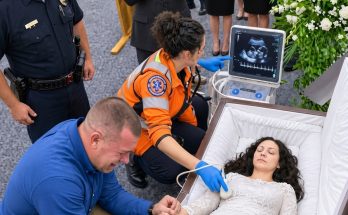
I also remembered the moment the funeral director opened the coffin.
I had asked for one last look because I couldn't accept goodbye.
I did not know I was asking the question that would save my family.
For a long time, people wanted to call me a hero for noticing that movement.
I never knew how to answer them.
I had done what any husband should have been able to do.
I had asked someone to check when something did not seem right.
The people responsible for medical care should have made those checks long before.
I could be grateful for the moment without pretending the failure was acceptable.
Ana read my expression.
“Thinking about that day?”
I nodded.
She put her phone away.
“I still don't remember it,” she said.
“I know.”
“But I remember waking up and seeing you.”
She touched my cheek.
“That's the part I want to keep.”
We stayed until Miguel began rubbing his eyes.
Then we went back to the car and made the journey home.
That evening, after his bath, I placed the wooden bird on the nursery shelf.
Ana put the yellow notebook beside it.
She had added one more page.
On it were the dates that mattered to us now.
Miguel's birth.
The day she opened her eyes.
Their first meeting.
His discharge.
Her return home.
Our first trip to the coast.
At the bottom she had written, *More to come.*
I looked at her.
“That's a long list.”
She smiled.
“We'll need another notebook.”
I went to the kitchen to make tea.
When I returned, she was standing beside Miguel's crib, humming the song she'd sung during her pregnancy.
He was asleep.
She brushed one finger lightly over his blanket.
I stood in the doorway and listened.
There had been a time when I believed my life ended at the side of a polished wooden coffin.
Now my wife was humming in a pale green room, and our son was dreaming beneath a blanket embroidered with clouds.
We had lost time we could never recover.
We had learned things about people we loved that would never become comfortable.
We still had appointments, difficult conversations, and uncertainty ahead.
But we also had tomorrow morning.
There would be laundry and breakfast and probably another spoon dropped on the floor.
Ana would remind me to buy fruit.
Miguel would laugh at something nobody else found funny.
And I would be there to hear it.
I set the tea on the shelf outside the nursery.
Ana turned toward me.
“Come here,” she whispered.
I went to her.
We stood together beside the crib until the song ended.
Then we switched off the light and walked into the rest of our life.
THE END
The End
Read more original stories on Feel Every Story.
The Heartbeat at the Crematorium Sent Us Racing Back Toward a Terrifying Uncertain Hope
Part 12 of 12