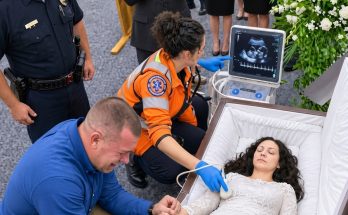
The first time Ana Clara tried to walk to the bathroom without calling for help, she frightened both of us.
I found her holding the edge of the bed, one foot planted uncertainly on the floor.
“Ana!”
She looked up, annoyed.
“I can do it.”
“Daniela said to wait for assistance.”
“Daniela says a lot of things.”
I pressed the call button.
Ana sat down reluctantly.
When the nurse arrived, she explained the risk of falling and offered to help.
My wife crossed her arms.
“Everyone treats me like glass.”
The nurse pulled up a chair.
“Then tell us what you want to do, and we'll work out the safest way.”
Ana looked embarrassed.
“I want to wash my face without somebody watching.”
They arranged a plan for more privacy with assistance close enough to keep her safe.
It wasn't perfect.
But Ana stopped arguing.
Afterward, she apologized to me.
“I'm angry all the time,” she said.
“You're allowed to be angry.”
“Not at everyone.”
I sat on the bed's visitor chair.
“We can work on that part together.”
Her physical recovery was slower than either of us wanted.
She had trouble remembering words when she was tired.
Some mornings light made her head ache.
She could walk short distances with support but needed to rest afterward.
There were follow-up appointments with rehabilitation specialists, occupational therapists, and doctors monitoring her injuries.
She hated the schedule.
Then she started bringing a notebook to every session.
She wrote down questions in large letters.
Whenever a doctor explained something, she asked for a plain-language version.
That was the Ana Clara I recognized.
One afternoon, she asked for copies of the hospital investigation updates.
Luciana arranged a meeting and told her what could be requested and what remained confidential during active reviews.
Ana listened without interrupting.
Then she asked a question I had not thought to ask.
“What happened to the patient whose death entry was put in my chart?”
The hospital representative looked at her.
“That patient died in our care,” he said. “Their family has been notified of the record error.”
Ana closed her eyes.
There had been another family grieving while ours stumbled through a nightmare.
The system's failures had reached beyond us.
“Were they told the truth?” she asked.
“The hospital has informed them of the confirmed record discrepancy and is reviewing the remaining documentation.”
Ana looked at Luciana.
“I want the review to protect other patients.”
Luciana nodded.
“We can make that a central part of what we seek.”
The hospital's representatives described immediate changes: additional identity checks, stricter release requirements, and mandatory physician verification before transfers.
Ana asked how those measures would be audited.
They agreed to provide written information when the review was complete.
I was proud of her.
I was also terrified that the effort would exhaust her.
After the meeting, she slept for three hours.
When she woke, she asked for soup.
I brought the wrong kind.
She smiled faintly.
“Some things never change.”
Miguel continued to improve in the neonatal unit.
He needed less respiratory support and was tolerating increasing amounts of nutrition.
The team explained that discharge would depend on several milestones, not a calendar date.
He needed to breathe safely, maintain body temperature, feed effectively, and gain weight reliably.
I copied each goal into the yellow notebook.
Ana drew a small box beside each one.
“Not a competition,” she said when she saw me checking them repeatedly.
“I know.”
“You don't look like you know.”
I put the pen away.
At the end of the third week, Miguel had a setback.
He developed signs of an infection and needed additional testing and treatment.
Dr. Martins explained the plan and the uncertainty.
I went back upstairs with my stomach knotted.
Ana saw my face before I spoke.
“What happened?”
I told her.
She asked about his temperature and oxygen.
Then she reached for the wheelchair.
“I want to go.”
The nurse helped us arrange a visit as soon as it was safe.
In the neonatal unit, Ana sat beside the incubator and watched Miguel sleep.
“I hate that he's suffering,” she whispered.
“So do I.”
“I should be able to fix it.”
I looked at her.
“You didn't cause this.”
She stared at her hands.
“I know that in my head.”
We stayed until the nurse said Miguel needed rest.
Ana asked the doctor to call her directly with updates.
He added her contact number according to the unit's procedures.
For the first time, she was taking part in decisions about our son rather than receiving every detail through me.
I realized how much she'd needed that.
On the fourth day, the infection markers began improving.
The doctors remained cautious.
But Ana smiled when Dr. Martins told her the treatment was working.
That evening, Beatriz brought a homemade meal to my apartment.
We ate together while the nursery stood ready down the hall.
She told me Gustavo wanted to apologize.
I put down my fork.
“Has he contacted Ana?”
“He asked me to ask her.”
“Then she can decide when she's ready.”
Beatriz nodded.
“He says he never wanted any of this.”
“I believe he didn't want the accident,” I said. “That doesn't excuse the documents.”
My mother-in-law looked at the table.
“I keep thinking about everything I signed for him.”
I reached across and touched her hand.
“You were trying to help your son. Now you can choose how to protect yourself.”
She told me Luciana had helped her change account access and set up alerts.
Gustavo no longer had permission to manage her bills.
I was relieved.
But Beatriz's face was sad.
“He thinks I don't love him anymore.”
“You can love him without giving him your bank card.”
She smiled for the first time that evening.
Ana Clara returned home for a short supervised visit several days later as part of her rehabilitation plan.
Paulo had installed a safer handrail at the entrance with the property manager's permission.
I had removed loose rugs from the hallway.
The apartment looked unfamiliar without them.
Ana stepped inside slowly.
She stopped in the living room.
Her eyes moved toward the photographs on the shelf.
Then she looked down at her own hands.
“It's strange,” she said. “I remembered the place while I was sick, but it doesn't feel the way I expected.”
I let her take her time.
She walked to the nursery with Daniela nearby.
The pale green walls reflected the afternoon sun.
The crib stood against the far wall.
Ana ran one finger along the rail.
“You finished it.”
“I used every screw.”
She laughed softly.
Then she opened the top drawer.
The labels were crooked.
Blankets.*
Sleep clothes.*
Too small already.*
She touched the last label and smiled.
“I knew he'd be bigger than his clothes in a week.”
I stood beside her.
“He'll catch up.”
She nodded.
We didn't need to make another promise.
Before leaving, she asked to sit in the nursery chair for a few minutes.
She looked at the empty crib.
Then she leaned her head against my shoulder.
“I thought I'd never see this room,” she whispered.
I held her hand.
Neither of us spoke until Daniela told us it was time to return.
The visit had cost Ana more energy than she wanted to admit.
Back at the rehabilitation ward, she slept through dinner.
The next morning, Daniela asked her to describe what had been difficult.
“Everything,” Ana replied.
Daniela waited.
Ana sighed.
“The stairs. The noise. Knowing people were looking at me.”
“What helped?”
“Marcos didn't hurry me.”
I looked down at my shoes.
Daniela smiled.
“That's useful information. Recovery is often about changing the environment and pacing activities, not just asking the body to do more.”
She helped Ana create a plan for visits that included rest periods, shorter walks, and fewer people in the room.
Ana added one rule in her own handwriting.
No surprise guests.*
I agreed immediately.
That afternoon, a psychologist met with both of us.
She asked Ana what frightened her most.
My wife thought for a long time.
“The feeling that someone else can decide what happens to my body,” she said.
She told the psychologist about waking with a breathing tube and not understanding where she was.
She told her how frightening it had been to learn about the coffin.
Then she admitted she was afraid to sleep.
“Every time I close my eyes, I wonder if they'll decide I'm gone again.”
My chest tightened.
I had slept badly too, but I hadn't imagined that fear.
The psychologist discussed trauma reactions and offered a plan for further support after discharge.
She suggested a simple routine for evenings, with medical questions handled in scheduled conversations rather than all at once before bed.
Ana agreed to try.
She also asked whether I would speak to someone separately.
I hesitated.
“Marcos keeps pretending he's fine,” she told the psychologist.
“I don't pretend.”
She raised an eyebrow.
It was such a familiar expression that I almost laughed.
“I'll make an appointment,” I said.
I did.
In my first session, I described the moment the coffin opened.
I described Ana Clara's cold hand and the movement beneath her dress.
Then I described the guilt I'd felt for signing paperwork without understanding it.
The psychologist did not tell me to stop feeling guilty.
He helped me separate the decisions I made under shock from the medical responsibilities that belonged to trained professionals.
I needed several sessions before I could say those words without arguing.
At home, I stopped avoiding the coat I'd worn to the funeral.
I took it to the cleaner.
When it came back, I hung it beside my other jackets.
It was still just a coat.
It did not have to remain the object that carried my worst memory.
Meanwhile, Luciana received a formal response from the lender.
The bank acknowledged a credible dispute over the guarantee and agreed to maintain a hold on collection efforts against Ana Clara while the investigation continued.
It also provided a list of the documents it had relied upon.
One contained a digital upload timestamp from Gustavo's office network.
Another identified an associate who had helped prepare the application.
Luciana forwarded the new material to the investigators through proper channels.
Ana Clara read the update with an expression I couldn't interpret.
“Do you want to talk?” I asked.
She looked at me.
“I want him to tell Mom the truth.”
“About the loan?”
“About all the money.”
She explained that Gustavo had borrowed from Beatriz repeatedly, often disguising the requests as short-term business advances.
Ana had tried to stop him without humiliating their mother.
But she had kept his secrets too.
“I thought I was protecting her,” she said. “I was really protecting him from consequences.”
I listened.
She was not making excuses.
She was trying to understand why she had waited so long.
“What do you want to do now?” I asked.
“I want Mom to have the records. Then she can decide.”
We arranged for Luciana to show Beatriz the documents with Ana's permission.
Beatriz listened, asked questions, and took them home.
She did not call Gustavo that evening.
She spent the night reviewing her finances.
The next morning, she came to the hospital with the biscuit tin again.
This time, it contained a notebook.
On the first page she had written every transfer she could remember.
“I want to know what I've done,” she said.
Ana reached for her hand.
“You were trying to help.”
Beatriz shook her head.
“I can love him and still ask for answers.”
Ana smiled faintly.
It was the first time I'd seen mother and daughter speak about Gustavo without either of them trying to shield the other.
Click here to continue reading: PART 9: We Learned to Live Together Again While the Hospital and Loan Investigations Continued
The Heartbeat at the Crematorium Sent Us Racing Back Toward a Terrifying Uncertain Hope
Part 8 of 12