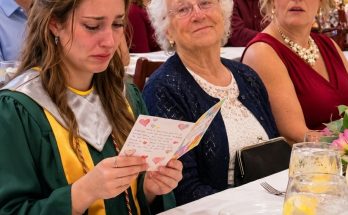
I kept Diane's graduation card in a drawer for three months.
The five crisp bills were still inside.
At first I couldn't bring myself to spend them.
Every time I opened the card, I heard her voice.
At least somebody in this family does things right.
I knew the money was meant as a gift.
I also knew the remark had been meant as a wound.
One evening, I took the card out and put it on the table.
Grandma was sorting through a basket of buttons.
"What should I do with this?" I asked.
She looked at the bills.
"What do you need?"
"New tires."
"Then buy tires."
"It feels wrong."
Grandma held a blue button up to the light.
"You can accept a useful thing without accepting the insult attached to it."
The next morning, I bought four tires and paid for an alignment.
It cost more than five hundred dollars.
I covered the difference from my first paycheck.
When I drove home, the car no longer shuddered on the highway.
That was enough.
A week later, Diane invited me for coffee.
She chose a café near the dental office her husband owned.
It was the first time she had asked to see me alone since graduation.
I nearly declined.
Grandma encouraged me to listen, but reminded me I could leave.
Diane arrived ten minutes late.
She ordered for herself, then studied me across the little marble table.
"Your grandmother tells me you got your first paycheck."
"I did."
"How's the job?"
"Good. Busy."
"I suppose that's something."
I put down my cup.
"Why did you invite me?"
She looked offended.
"Can't an aunt take her niece to coffee?"
"Of course. I just haven't seen much of that lately."
Diane folded her napkin.
"I'm concerned about my mother."
I waited.
"She's eighty-six. She has a house that needs upkeep. She has savings that may not last. And she suddenly started making financial decisions with you."
"She has an independent lawyer and financial planner."
"You told me that."
"Then why are you worried?"
Diane took a breath.
"Because she used to discuss these things with me."
"Did she? Or did you tell her what to do?"
Her eyes flashed.
"That's unfair."
"It might be. Tell me what it felt like from your side."
She looked down at her hands.
For several minutes, she spoke about her childhood.
Her father had died when she was nineteen.
Grandma had worked two jobs for a while.
Diane had watched bills pile on the kitchen counter.
She had promised herself she would never live that way again.
"I married a stable man," she said. "I made sure we could pay our bills. I thought Mom would finally let me help her."
"She does let you help sometimes."
"Only when it's little things."
"Maybe because little things don't require giving up control."
Diane looked at me sharply.
"You sound like that lawyer."
"Maybe he has a point."
She pushed her coffee aside.
"You don't understand how exhausting it is to worry about someone who refuses practical help."
"I understand being worried. I don't understand laughing at her in front of twelve people."
She stiffened.
"It was a joke."
"It hurt her."
"She didn't act hurt."
"She usually doesn't."
Diane stared at the window.
I felt the conversation slipping away.
Instead of arguing, I told her what Grandma had said about the $5 bill.
The first deposit was made the week I came to live with her.
The account was a promise she kept to herself for eighteen years.
"You didn't ask what it meant," I said. "You just decided it was pathetic."
Diane's mouth tightened.
"I didn't know."
"I know."
She rubbed her forehead.
"Mom could have told me."
"You could have asked."
We sat in silence.
When the bill arrived, Diane reached for it.
I asked to pay for my own coffee.
She looked surprised, then nodded.
Outside, she said she still believed Grandma should consider moving.
"You can believe that," I told her. "But she's allowed to disagree."
Diane did not hug me goodbye.
She did say she would think about the lunch.
I drove back to work, unsure whether anything had improved.
That afternoon, Mateo read two pages aloud without my help.
He grinned.
I felt myself grin too.
When I got home, Grandma asked how coffee had gone.
"She listened a little."
"So did you?"
"I tried."
"Then you both did something difficult."
The next morning, Diane sent Grandma a text.
It said: I am sorry I made fun of your gift to Annie. It was unkind.
Grandma read it twice.
She didn't call Diane immediately.
She placed the phone beside her breakfast plate.
"That's a start," she said.
On the drive home from coffee with Diane, I pulled into a parking lot and sat for a while.
I replayed the conversation.
Some of my answers had been sharp.
Some had been fair.
I was beginning to understand that a boundary could be clear without being cruel.
That was not a lesson I had learned from Diane.
It was something Grandma practiced whenever she sent a meal to a neighbor but refused to loan money she needed for bills.
She could care about someone and still say no.
I took out my phone and wrote a message to Diane.
Thank you for meeting with me. I know you worry about Grandma. I want her safe too. Please talk with her before making plans for her money or house.
I read it twice and sent it.
Diane did not answer that day.
The next morning she replied with two sentences.
I hear what you're saying. I need some time to think.
That was more than I expected.
At work, a volunteer named Lena asked me for advice about a parent who kept changing the time of a child's reading session.
I nearly told her about my own family.
Instead, we looked at the program's schedule and decided what could be accommodated.
We offered the parent two reliable options.
The parent was frustrated at first.
Then she chose one and thanked us.
It reminded me that rules could make relationships less confusing.
People knew what to expect.
I had spent years reacting to Diane's moods instead of deciding what behavior I could accept.
Now I was learning to respond instead of simply absorbing.
That Saturday, Grandma and I visited a small farmers' market.
She wanted apples for a pie.
We walked past stalls selling bread, honey, and flowers.
At one table, a woman recognized Grandma from the neighborhood.
She asked how her health was.
Grandma said she was well enough to argue with me over the price of pears.
The woman laughed.
She told me Grandma had helped her family when her husband lost work many years ago.
Grandma had cleaned their kitchen and refused payment for a week.
"You never told me that," I said after we left.
"It wasn't your business."
"It was kind."
"It was necessary."
The woman's story made me think about generosity.
Diane's five hundred dollars had been useful.
Grandma's savings were useful too.
But kindness couldn't always be measured in an amount.
It might be an afternoon of time when someone was overwhelmed.
It might be a ride to the clinic.
It might be asking a question without judging the answer.
I helped Grandma carry the apples home.
We baked the pie together.
She showed me how to pinch the crust so the filling wouldn't leak.
I was terrible at it.
The edge of my side looked like a row of broken teeth.
She said it would taste fine.
It did.
That night, Diane called.
She asked Grandma whether she could come over the following Sunday.
Grandma glanced at her calendar.
"Come after two," she said. "I'm busy in the morning."
Diane did not ask what she was doing.
She simply agreed.
I listened from the hallway, amazed at how ordinary the exchange sounded.
Later, Grandma told me Diane used to be fearless when she was young.
She climbed trees and challenged boys twice her size.
"Maybe she isn't used to being afraid," Grandma said.
"She's afraid all the time now."
"Perhaps. It doesn't make her right. But it might help us talk to her."
I thought of the way Diane had stared at the window in the café.
I hoped she would learn that protecting someone didn't require owning their decisions.
I also knew I could not learn that lesson for her.
A few days after Diane apologized, Grandma wrote her a short reply.
Thank you for saying that. I would like us to speak more kindly to each other.
She let me read it before sending.
"That's all?" I asked.
"That's enough for now."
Grandma did not pretend the apology erased years of comments.
She also did not use the opportunity to punish Diane.
On Sunday, they had tea on the porch.
I stayed inside and worked on next month's reading schedule.
Through the open window, I heard them discussing the weather, a cousin's new baby, and the old church they had attended years ago.
There was an awkward pause when Diane mentioned the house.
Grandma reminded her that the roof work was arranged.
Diane changed the subject.
I smiled at my laptop.
Sometimes progress meant a conversation ending without a fight.
Later, Diane asked whether I wanted to join her and Grandma for lunch next month.
I said I would check my schedule.
She accepted the answer.
That freedom to choose made me more willing to consider it.
I wondered whether she understood how much easier family life could become when invitations were really invitations.
A month later, Diane came to the reading center's open house.
I had invited several relatives, and I didn't expect her to attend.
She stood near the back while the children read short passages they had practiced.
Afterward she asked how many families participated.
I gave her the figures.
She nodded thoughtfully and offered to donate books.
I explained that we needed specific titles and that donations had to fit the program's guidelines.
She asked for the list instead of buying whatever she liked.
Two weeks later, the requested books arrived.
There was no speech or public announcement.
I thanked her in a private message.
She replied that she had enjoyed seeing the children.
It felt like a new way for us to relate.
We could share something useful without anyone having to prove who mattered most.
Grandma said she was pleased.
Then she asked whether I had remembered to eat lunch.
Click here to continue reading: PART 8: A Surprise Visit From My Mother Forced Me to Decide What Kind of Relationship I Wanted
The Five-Dollar Bill My Aunt Mocked Carried Eighteen Years of My Grandmother’s Quiet Promises
Part 7 of 12