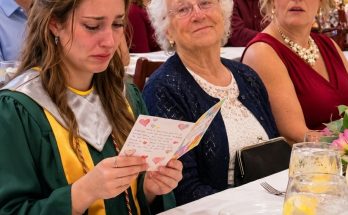
Christmas dinner was smaller than the graduation lunch.
There were six of us around Grandma's table.
Diane and her husband came with roasted vegetables.
Mrs. Chen brought rice cakes.
A cousin supplied bread.
Laura joined us for the afternoon after asking weeks in advance.
I was nervous about having everyone together.
Grandma looked entirely unconcerned.
She had spent the morning directing me from her chair as I prepared the meal.
"Not so much salt," she said.
"You haven't tasted it."
"I can see the salt shaker."
I put it down.
She smiled.
When Diane arrived, she handed Grandma a wrapped box.
Inside was a new brown handbag.
It was simple and sturdy, with a clasp that worked.
Grandma ran her fingers over the leather.
"My old purse is still useful."
"I know," Diane said. "I saw the clasp and thought you might like a choice."
Grandma looked at her daughter for a long moment.
"Thank you."
Diane seemed almost startled by the gratitude.
At dinner, the conversation remained careful.
We talked about work, the weather, and a neighbor's new dog.
Laura asked Mrs. Chen for her rice cake recipe.
Diane asked about my reading program.
She listened to the answer without mentioning my salary.
After we cleared the plates, Grandma asked me to make coffee.
Diane stayed at the table.
I could hear their voices from the kitchen.
"Mom," Diane said, "did you ever think I was ashamed of you?"
Grandma was quiet.
Then she answered.
"Yes."
The word stopped me.
I kept my hands on the coffee pot.
Diane spoke softly.
"I wasn't ashamed of you. I was ashamed that things were hard for us."
"You often made it sound the same."
Diane sniffed.
"I thought if I earned enough, nobody could look down on our family."
"I never looked down on us," Grandma said.
"I know that now."
I heard a chair scrape.
Then Diane asked the question Grandma had wanted for years.
"Do you think you had a good life, Mom?"
Grandma took her time.
"Not an easy one. But yes. There were good people in it. There was work I was proud to do. I raised two daughters and my granddaughter. I've had sorrow. I've had joy. I don't measure all that by the size of my bank account."
Diane began to cry.
Grandma did not rush to reassure her.
She let her daughter sit with the answer.
I came in with the coffee when they were ready.
Diane wiped her face.
No one mentioned the tears.
Later, Laura and I washed dishes together.
She handed me plates while I rinsed.
It was a small, domestic thing we had rarely done.
"You look happy," she said.
"I'm tired."
"That too."
She asked whether she could visit the reading program someday.
I told her visitors needed approval and background screening for certain volunteer roles.
"Of course," she said. "I wasn't asking you to make an exception."
We talked about the center's volunteer process.
It felt ordinary.
When it was time to leave, Laura asked for a hug.
I gave her one.
It lasted a little longer than the last one.
Diane helped Grandma clear the table.
Before leaving, she turned to me.
"I was cruel at your graduation lunch," she said.
"Yes, you were."
"I thought the money I gave you was the important part. I was wrong."
I waited.
"I'm sorry, Annie."
I believed the apology was genuine.
I also knew a single apology couldn't rewrite years of remarks.
"Thank you for saying that," I answered.
She nodded.
She didn't ask me to forgive her on the spot.
That was another change.
After everyone left, Grandma and I sat by the tree.
She held the new purse on her lap.
"It's a nice bag," I said.
"It is."
"Will you use it?"
"Sometimes."
"What about the old one?"
She glanced toward the coat rack.
"I'll keep it. It carried a lot of things worth remembering."
I understood.
That old purse had carried grocery money, bus passes, tissues, school notes, and the worn five-dollar bill.
It had held more than Diane ever imagined.
In the weeks before Christmas, I had been tempted to cancel the dinner several times.
I worried about Laura and Diane sitting across from each other.
They had years of unresolved arguments.
I worried Diane would make a comment about money.
I worried Laura would feel unwelcome.
Most of all, I worried Grandma would spend the holiday managing everyone else's emotions.
So I called each person separately.
I told Diane that the dinner was not a chance to discuss Grandma's house or finances.
She sounded irritated.
Then she agreed.
I told Laura she was welcome for the afternoon and that Grandma would need rest in the evening.
She thanked me for being clear.
I told Grandma what I had said.
She listened, then reminded me not to act like the owner of the house.
"It's still my dinner," she said.
"I know."
"Then I will decide where everybody sits."
I laughed.
We made a seating plan.
It seemed ridiculous until I noticed how much calmer I felt.
Diane and Laura wouldn't be beside each other.
Mrs. Chen would sit near Grandma.
I would be close enough to help serve food without becoming a referee.
We also planned a shorter meal than the elaborate celebrations Diane usually preferred.
Grandma wanted roast chicken, potatoes, vegetables, and apple cake.
She didn't want six courses or expensive flowers.
She wanted everyone comfortable enough to eat.
On Christmas Eve, I went shopping with a list she had written.
The grocery store was crowded.
People rushed past the shelves with tired faces and overflowing carts.
I found myself comparing prices out of habit.
Then I stopped at a display of good coffee.
Grandma enjoyed it but rarely bought it because it cost more than her usual brand.
I put a bag in the cart.
It was not an extravagant purchase.
It was simply something I knew she would enjoy.
Back home, Grandma noticed the bag.
"You shouldn't have."
"I wanted to."
She looked pleased despite the protest.
On the morning of the dinner, the kitchen smelled of roasting chicken and cinnamon.
I put on music while chopping vegetables.
Grandma hummed along.
When the first guest arrived, I was still wearing an apron.
Mrs. Chen helped carry plates to the table.
She complimented the new lighting on the back steps.
Grandma said it made the garden look like a hotel courtyard.
We laughed.
When Laura walked through the door, she paused to ask whether she should remove her shoes.
Grandma told her to come in and warm up.
Their hug was careful.
Neither pretended the past was uncomplicated.
Diane arrived a few minutes later.
She and Laura exchanged greetings.
Then Diane complimented her sister's green scarf.
Laura said she had knitted it herself.
The conversation was awkward but civil.
That was more than enough for a first holiday together.
At dinner, we told stories about the year.
Mrs. Chen described her new gardening club.
Diane's husband talked about renovating the waiting room at his office.
I told everyone about Mateo's reading progress.
Grandma asked each person questions and listened to the answers.
She did not need to fill every silence.
Sometimes the room was quiet except for forks against plates.
Nobody panicked.
By dessert, I realized I had stopped bracing for an argument.
I could actually taste the apple cake.
The recipe was the one Laura had found.
We had followed Grandma's instructions and added extra cinnamon.
Diane took a second slice.
"I remember this," she said.
Laura smiled.
"You used to steal pieces before supper."
Diane laughed.
"You told on me every time."
For a moment, they sounded like sisters rather than rivals.
Grandma watched them without saying anything.
I knew she was listening closely.
I also knew she was wise enough not to interrupt the moment with a speech.
Later, when Diane asked the question about whether Grandma had lived a good life, the answer came from years of work and worry.
It couldn't have been delivered as a neat family lesson.
We had to hear it in the room where so much of that life had taken place.
The morning after Christmas, Diane called Grandma to ask whether she had enjoyed dinner.
Grandma said she had.
Then Diane asked whether she could help clear out the attic in January.
"We'll look at it together," Grandma said. "I don't want anything thrown away without asking."
Diane agreed.
A few weeks later, she arrived in old clothes and carried boxes downstairs while Grandma decided what to keep.
They found childhood drawings, family photographs, and a wooden jewelry box that had belonged to Grandma's mother.
Diane opened the box carefully.
Inside were costume earrings and a small silver brooch.
"I thought this was lost," she said.
Grandma smiled.
"You used to wear it when you played dress-up."
Diane held the brooch in her palm.
"Can I keep it?"
Grandma considered the request.
"Yes. If you promise you'll wear it instead of hiding it away."
Diane pinned it to her sweater.
She looked almost shy.
I watched them continue sorting.
The afternoon passed without anyone calculating what the contents might be worth.
There were no arguments over ownership.
They were simply remembering a shared past.
After Diane left, Grandma said the attic felt lighter.
She meant the boxes.
I suspected she meant something else too.
The attic project continued over several weekends.
Diane and Laura both came once, though not on the same afternoon.
They took home copies of photographs Grandma wanted them to have.
We made a list of where the originals would be stored.
Nobody was promised a valuable heirloom in exchange for helping.
Grandma decided which things mattered to her and invited opinions when she wanted them.
At one point Diane suggested hiring an organizer.
Grandma said she preferred doing a little at a time.
Diane accepted the answer.
After she left, Grandma told me she enjoyed seeing her daughter help without taking charge.
She said it felt like having Diane back in the house, instead of having a manager inspecting it.
I understood what she meant.
The room felt warmer when nobody had to defend a decision before making it.
We closed the attic door and had tea together.
Click here to continue reading: PART 12: Years After That Graduation Lunch I Finally Understood What Grandma Had Been Giving Me All Along
The Five-Dollar Bill My Aunt Mocked Carried Eighteen Years of My Grandmother’s Quiet Promises
Part 11 of 12