Laura came to town in November.
She called three days beforehand and asked whether we could meet for lunch.
"Not at the house," she said. "I don't want Grandma feeling she has to host me."
I agreed to meet at a diner near my office.
I spent the next two days regretting it.
I had not seen my mother in almost two years.
The last visit had ended with her crying at the bus station while I stood beside her feeling numb.
I had been angry that she wanted reassurance I couldn't give.
Now I worried she would ask again.
Grandma didn't pressure me.
She asked whether I wanted her to come.
I said no.
"All right," she answered.
Then she packed a banana and a sandwich for my lunch the next day, as if I were heading to school.
Laura was already in a booth when I arrived.
Her hair was shorter.
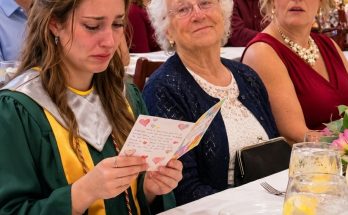
She wore the same green jacket from her picture.
When she saw me, she stood.
For a moment neither of us moved.
"Hi, Annie."
"Hi."
She reached toward me, then stopped.
"Can I hug you?"
I nodded.
The hug was brief and awkward.
But she let go when I did.
That helped.
We ordered soup.
She asked about work.
I told her about the literacy program, the volunteers, and Mateo.
She listened without turning the conversation back to herself.
Then I asked about her job.
She still worked at the recovery center.
She handled scheduling and helped new clients find transportation.
"Some days I feel useful," she said. "Some days I feel like I'm still learning to be an adult."
I smiled despite myself.
"I think most adults feel that way."
Our food arrived.
For a while, we ate quietly.
Then I brought out the letter she had sent.
It was folded inside my bag.
"Thank you for writing this."
She looked relieved.
"I rewrote it about eight times."
"I believe you."
I told her the part that stayed with me.
She had written that I didn't owe her a relationship because she had contributed money.
"I meant it," she said.
"I want to believe you."
"Then you don't have to decide today."
We talked about the years I lived with Grandma.
Laura asked what I remembered.
I told her about the red backpack and the locked apartment.
Her face tightened.
She did not deny either memory.
"I remember that day," she said. "I thought I could get back in time. I was wrong."
I watched her carefully.
"I was scared."
"You should never have been left there."
There were tears in her eyes.
She wiped them away herself.
She didn't ask me to comfort her.
That was different from our last meeting.
"Grandma saved for me," I said. "But she was doing everything else too."
"I know."
"She worked when her knees hurt. She worried about rent and groceries. She taught me how to do my homework and file taxes."
"I know," Laura repeated.
"Sometimes I feel like thanking her isn't enough."
Laura looked at her hands.
"It probably isn't. But you can keep showing up for her. That matters."
After lunch, we walked along the waterfront.
It was cold enough that I wished I had brought gloves.
Laura offered me hers.
I declined.
We stopped near a bench overlooking the water.
She asked whether we could speak by phone once a month.
"We can try," I said.
"And if you don't want to talk one month, tell me. I won't keep calling."
I appreciated the boundaries more than any apology.
Before we separated, Laura gave me a small package.
Inside was a photograph of me at six, holding a paper crown.
On the back, she had written the date.
"You made me that crown," I said.
"You insisted I wear it too."
I remembered the day.
Not every detail.
Just the sound of us laughing in a kitchen.
I took the photograph home and showed Grandma.
She smiled.
"You both look happy."
"We were, that day."
"Good memories are allowed to be real," Grandma said. "They don't erase the bad ones."
I placed the picture beside my graduation photograph.
The following week, I called Laura for ten minutes.
It was an ordinary conversation.
She told me she was making lentil soup.
I complained about the rain.
We didn't discuss the past at all.
When I hung up, I felt cautiously hopeful.
That was enough for now.
After my first lunch with Laura, I spent several days waiting for the feeling to settle.
I had expected either relief or anger.
Instead, I felt both, along with a strange sadness for the childhood we could not recover.
At work, I helped prepare a family literacy evening.
Parents came with children of different ages.
Some arrived in uniforms after long shifts.
Some looked nervous about reading aloud.
One father told me he had left school early and didn't know how to help his daughter with homework.
I showed him simple ways to ask questions about the pictures and story.
He tried with her.
By the end of the session, they were laughing together.
On the bus home, I thought about Laura.
I had spent years comparing her with Grandma.
Grandma showed up.
Laura often hadn't.
That was true.
But it was also true that people could learn new skills late in life.
Not every failure had to be the final description of a person.
I wasn't required to trust Laura before she earned that trust.
I could still leave room for evidence that she was changing.
I decided to tell her exactly what I needed.
On our next call, I said I preferred planned conversations rather than surprise visits.
I asked her not to tell other relatives details of our talks.
I also said I didn't want her to criticize Grandma for choices she had made while raising me.
Laura listened.
"I can do that," she said.
"And if you can't, tell me instead of pretending."
"All right."
She then asked what I needed from her.
I wasn't ready for the question.
After a moment I said, "Please don't ask me to tell you everything's okay."
She was silent.
Then she said, "I can try to remember that."
A few weeks later, she called to cancel our planned lunch.
She had been asked to cover a shift at the recovery center.
She sounded nervous, as though expecting me to interpret the cancellation as abandonment.
"Thanks for telling me in advance," I said.
"I didn't want you waiting somewhere."
We chose another date.
She kept it.
That small reliability meant more than a long apology.
When we met, she brought an old recipe card written by Grandma's mother.
It was for apple cake.
She had found it in a box of family papers.
"I thought Grandma might like it," she said.
"She will."
We looked at the handwriting together.
The ink had faded around the edges.
Laura told me the cake had been made for birthdays when she and Diane were young.
She remembered Diane sneaking pieces before dinner.
I tried to picture my aunt as a mischievous child.
It was difficult.
Laura laughed.
"She wasn't always so serious."
"Grandma told me that."
"She used to defend me when kids made fun of my clothes."
I looked up.
"Really?"
"Really. She was a very good big sister for a while."
That memory didn't undo Diane's later behavior.
It did make her less like a fixed character in a story.
At home, I gave Grandma the recipe.
She recognized it immediately.
"I haven't seen this in forty years."
She held it near the window for better light.
"Your great-grandmother always added too much cinnamon."
"Should we make it?"
"Of course. And we'll add too much cinnamon."
The next Sunday, the three of us baked together.
Laura measured flour.
Grandma supervised from a chair.
I mixed the batter.
Nobody tried to turn the afternoon into a confession or a ceremony.
We talked about apples and oven temperatures.
When the cake was ready, we ate warm slices at the kitchen table.
Laura stayed for an hour, then went home.
Grandma looked tired but happy.
"That was nice," she said.
I agreed.
Nice was a small word.
For us, it was enough.
One Saturday, Laura and I visited a used-book sale at the community center.
She had asked whether I wanted company, and I said yes.
We moved slowly between tables covered in donated books.
She picked up a cookbook with a torn cover.
"I used to make this soup when you were little," she said.
"I don't remember."
"That's okay."
She put the book back without insisting I should remember.
We found a collection of children's poems Grandma used to read aloud.
I bought it for two dollars.
Laura paid for a gardening guide as a gift for Grandma.
On the way home, we stopped for coffee.
She asked what I hoped to do in five years.
I said I wanted stable work, a place of my own, and enough savings that one broken appliance wouldn't frighten me.
"That sounds sensible," she said.
"What do you want?"
She thought for a moment.
"To keep living honestly. To be useful. And to know you without trying to make you forget who I used to be."
We sat quietly.
It wasn't a perfect answer.
It was an answer I could believe she meant.
When we reached Grandma's house, Laura handed her the gardening book and asked permission to stay for tea.
Grandma said yes.
No one made a speech about family healing.
We sat together and discussed tomatoes.
That winter, Laura sent me a postcard from a training conference.
She wrote about a session on rebuilding trust through reliable behavior.
I smiled at the subject because she knew I would recognize it.
She didn't claim that attending a conference made her a different person.
She simply said the workshop had given her something to think about.
I put the postcard in my desk drawer.
Later, when I had a hard day, I reread it and remembered that progress could be slow without being meaningless.
I also reminded myself that I was free to pause our contact if I needed to.
The relationship felt healthier because it was chosen, not demanded.
Grandma listened when I told her.
She said she had waited many years to hear Laura speak about responsibility without excuses.
Then she changed the subject and asked what we were making for dinner.
Life kept moving around our difficult conversations.
Click here to continue reading: PART 9: When Grandma Fell in the Garden We Learned Why Financial Independence Was Only One Part of Safety
The Five-Dollar Bill My Aunt Mocked Carried Eighteen Years of My Grandmother’s Quiet Promises
Part 8 of 12