The conference room still smelled of coffee when Gavin told me to leave.
My name is Christopher Hale.
I had spent four years building campaigns at Eastbridge Creative, a small marketing agency that survived on long hours and promises about what would happen after the next big account.
That morning, I was supposed to lead an eight-thirty presentation.
Instead, I had stopped on the shoulder of Route 16.
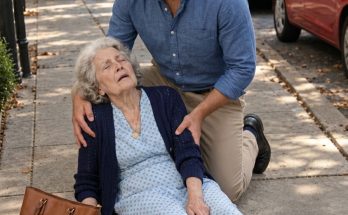
An older woman lay beside a stopped blue sedan.
Her shopping bag had spilled across the gravel.
An orange rolled toward the drainage ditch.
I saw her fall while I was approaching the exit.
I pulled over, turned on my hazard lights, and called emergency services before running to her.
She was awake for a moment.
Her skin looked gray beneath the morning sun.
“Please,” she whispered.
I knelt beside her.
“I've called for help.”
She reached for my sleeve.
“I can't breathe properly.”
I gave the dispatcher our mile marker and repeated what I could see.
The woman tried to sit up.
I asked her to remain still.
A delivery driver parked behind my car and offered his first-aid kit.
Another motorist directed traffic away from us.
I stayed until the paramedics arrived.
One of them asked what time she had collapsed.
I checked my phone.
Eight seventeen.
I had missed the start of the presentation.
I sent our account manager, Priya, a message while the paramedics worked.
Roadside medical emergency. I'm with the ambulance crew. Please start without me. Deck is on the shared drive.
My phone showed the message had been delivered.
By the time I reached Eastbridge, the lobby clock read nine twenty-six.
Gavin was waiting.
“What the hell do you mean you were helping somebody?”
I explained about the woman.
He asked whether she was my wife.
Then whether she was my mother.
When I told him she was a stranger, he said I should have kept driving.
I stared at him.
“You can't mean that.”
“I mean I had clients in that room.”
“The ambulance had to take her to the hospital.”
“And because of that, we lost the account.”
I looked through the glass wall.
My presentation remained on the monitor.
The empty chairs faced it in two orderly rows.
I had stayed until two in the morning finishing those slides.
I had checked our calculations three times.
Gavin told me to pack my things.
He said I was finished.
Nobody argued with him.
I left before my coworkers could see me cry.
Inside my car, I gripped the steering wheel until my fingers hurt.
I called my wife, Melissa.
She answered from the school office where she worked.
“Chris? What's wrong?”
“I lost my job.”
The words sounded unfamiliar.
She waited while I told her everything.
Then she asked the first sensible question anyone had asked all morning.
“Is the woman alive?”
“I don't know.”
“Then find out what you can. And come home.”
I looked toward the office windows.
Four years of my life stood behind them.
I had no idea that the woman beside the highway was already asking the hospital staff to help her find the man who had stopped.
Before the paramedics arrived, the dispatcher asked whether she was breathing normally.
I answered that she was breathing, but that each breath looked difficult.
“Don't give her anything to eat or drink,” the dispatcher said.
I moved a loose shopping bag out of the roadway and made sure other cars could see us.
A truck passed close enough to rattle the door of my sedan.
The delivery driver, whose name I later learned was Omar, stood behind the woman to block the wind.
His hands were shaking too.
“You know first aid?” he asked.
“Not enough.”
“Me neither.”
We followed the dispatcher's instructions and avoided moving her unnecessarily.
The woman tried to speak again.
“I was just getting groceries.”
“I know.”
“Such a stupid place to stop.”
“You didn't choose it.”
I wondered whether she had anyone expecting her home.
I wondered whether she was thinking about children or a partner.
But the dispatcher told me to keep my questions simple.
I asked her name.
She said Eleanor.
I repeated it back.
It seemed important to use her name rather than call her the lady in the road.
When the ambulance finally appeared, relief made my knees weak.
The crew examined her and asked us to step back.
I watched them work from near my car.
One paramedic returned briefly to confirm the time of the collapse.
Then the ambulance doors closed.
I wrote the emergency call number on the back of a gas receipt because I didn't know whether someone would need to contact me.
Only then did I notice seventeen messages on my phone.
Gavin had sent six.
The first asked where I was.
The last said my absence was unacceptable.
None asked whether the woman survived.
As I merged back into traffic, I rehearsed what I would say.
I would explain calmly.
I would apologize for the delay.
I would offer to send a revised presentation that afternoon.
I never imagined I wouldn't be given the chance.
At the office, the elevator seemed too slow.
I climbed two flights of stairs instead.
By the time I reached the reception desk, I was sweating through my shirt.
The receptionist started to speak.
Then Gavin appeared behind her.
His expression told me he had already decided what this meeting was going to be.
The conversation was over before it began.
That detail bothered me for weeks.
Not because I believed every explanation deserves forgiveness.
Because he hadn't needed to agree with my decision to listen to it.
On the drive home, I pulled over twice to steady myself.
At the second stop, I found the gas receipt in my pocket.
The emergency number was written across the back in my own uneven handwriting.
I held it for a long time.
It was evidence that I hadn't imagined that morning.
A woman had collapsed.
I had called for help.
And whatever Gavin said, those facts would remain facts.
The first time I told the story at home, I left out the way the office had gone quiet.
I could describe Gavin shouting.
I could describe the boxes and the empty conference room.
But explaining why nobody defended me made my face burn again.
Melissa noticed.
“Did anyone talk to you afterward?”
“Priya called.”
“Anyone else?”
“No.”
I wanted to say they were cowards.
Then I remembered how often I had kept quiet when Gavin treated another employee unfairly.
A young designer had once been criticized in front of a client for a change Gavin himself had requested.
I had talked to her afterward.
I had not challenged the story in the room.
At the time, I told myself I was protecting the project.
Now I wondered whether I had simply been protecting myself.
The memory was uncomfortable.
It didn't mean I deserved to be fired.
It meant I could learn something beyond the obvious lesson about Gavin.
Later that night, Priya sent me a brief message.
I'm sorry I couldn't speak up in the office.
I typed three different replies.
The first was angry.
The second was too forgiving.
I finally sent: Thank you for calling. I understand why you're worried. I appreciate the facts you shared.
It was enough for that evening.
I went downstairs to lock the back door.
The porch light lit up the tomato pots Melissa had planted in spring.
A little green fruit had appeared on one stem.
I remembered promising her I would help build a trellis when the campaign ended.
There was always another campaign.
The trellis still hadn't been built.
I found the lumber beside the shed.
On Saturday, I put it together with June holding the level.
She took her responsibility very seriously.
The trellis leaned slightly to one side.
Melissa said it was perfect.
For the first time in days, I believed her.
Click here to continue reading: PART 2: A Cardboard Box, Two Frightened Daughters, and the First Call From the Hospital
The Eight-Thirty Presentation I Missed Because a Stranger Collapsed Beside the Highway
Part 1 of 12