The offer from the coalition arrived on a Thursday afternoon.
I read it twice before telling Melissa.
The salary was lower than at Eastbridge.
The benefits were clearer.
The schedule allowed me to leave early twice a month for volunteer events, provided major deadlines were covered.
There was a probationary period and ordinary performance reviews.
It was a job, not a reward.
Melissa sat beside me at the table.
“Can we afford the difference?”
“Let's check.”
We worked through the numbers.
The unemployment payments would stop when I began earning wages.
We would still need to replace some savings used during the gap.
We discussed retirement contributions.
We talked about car repairs, school lunches, and the trip we had postponed.
Then Melissa asked what I wanted.
“I want work I can stand behind.”
“That's important.”
“I also want to be able to pay our bills.”
“Also important.”
We laughed.
We decided the offer could work if I accepted it with a realistic budget.
I emailed Sonya two questions about health coverage and the start date.
She answered the next morning.
The response was straightforward.
No pressure.
No grand promises.
I accepted.
When I told Eleanor, she congratulated me.
Then she asked whether I had reviewed the retirement plan.
I sighed.
“You are impossible.”
“I have outlived two accountants. I know what questions to ask.”
The girls celebrated by making a banner from construction paper.
It read GOOD LUCK DAD in letters too large for the kitchen wall.
Nora drew a little book beside my name.
June drew a person with a cape.
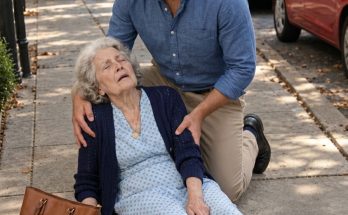
“That's you helping the lady,” she said.
I crouched beside her.
“I wasn't wearing a cape.”
“People don't always need one.”
I kissed the top of her head.
Later, I spoke with Rafael about whether to pursue further action against Eastbridge.
He explained the possible claims, costs, uncertainty, and deadlines.
The unemployment decision did not automatically establish wrongful termination.
We would need to evaluate the law and evidence separately.
I asked for time to consider it.
I didn't want revenge to become my second full-time job.
But I also didn't want fear to make the decision for me.
We agreed to revisit the question after I settled into the new role.
On my last weekday before starting, I drove past Eastbridge.
The windows looked exactly the same.
The building hadn't changed.
I kept driving.
Before I signed the offer, I visited the building again on an ordinary workday.
The receptionist showed me the staff entrance and where employees stored their lunches.
I watched volunteers carry boxes of books through a doorway.
Nobody seemed to be performing for an interview panel.
Sonya met me in the hallway and asked whether I had remaining questions.
I asked how performance concerns were addressed.
“Privately, as early as possible,” she said. “We document expectations and give people a chance to respond.”
I asked what happened when someone needed an unexpected absence.
“We work out coverage where we can. Emergencies don't always give us advance notice.”
I wanted to believe her.
I also knew words were not guarantees.
Still, she answered without becoming defensive.
That mattered.
On the drive home, I stopped by the gas station where I had once bought coffee before long agency meetings.
The same cashier was behind the counter.
“Been a while,” he said.
“Different route now.”
He handed me my receipt.
I realized I no longer had to plan every morning around Gavin's moods.
The thought was both freeing and unsettling.
At home, Melissa suggested we celebrate the offer with dinner out.
I reminded her of the budget.
“We can afford pizza,” she said.
We went to the little restaurant near the park.
June ordered the largest glass of lemonade I had ever seen.
Nora asked whether my new colleagues would be nice.
“I hope so.”
“What if one of them isn't?”
“Then I'll address it rather than pretending it doesn't matter.”
Melissa reached across the table and squeezed my hand.
The conversation turned to school.
June had been chosen to read a paragraph during assembly.
Nora was worried about a science assignment.
I listened.
For months, every family discussion had seemed to circle back to my firing.
Now other people's problems were allowed to take up space.
That was a small sign of recovery.
Later, Rafael explained that the remaining employment dispute could involve negotiation or litigation, but that each route carried costs and risk.
I asked him to put the options in writing.
He did.
We took a weekend to think.
I didn't want to rush into a settlement because I was tired.
I also didn't want to spend the next year measuring my days by letters from a lawyer.
The decision was ours to make.
I appreciated having a choice after a morning when Gavin had given me none.
Before my start date, I made a list of questions I wanted to ask during orientation.
How would projects be assigned?
Who approved last-minute changes?
What happened when an employee became unavailable unexpectedly?
Melissa read it over breakfast.
“You're allowed to ask about normal working conditions,” she said.
“I know. I just don't want to seem difficult.”
“You've confused being easy to manage with being a good employee.”
I stared at her.
She continued spreading jam on her toast.
“I married you. I know the difference.”
At the orientation, Sonya answered the questions without making me explain why I was asking.
She showed me the shared project board.
Every major assignment had an owner, a backup, and a date for checking progress.
We discussed which decisions could be made independently and which needed approval.
It was ordinary operational planning.
No one treated it as a sign I lacked commitment.
I drove home relieved and a little ashamed of how extraordinary that had seemed.
That night, I placed the old Eastbridge badge in a drawer rather than throwing it out immediately.
I wanted to keep it until I could look at it without feeling angry.
A few months later, I found it again.
The photograph showed a man who was trying hard to be valuable.
I didn't dislike that man.
I only wished someone had told him sooner that value and constant availability weren't the same thing.
Click here to continue reading: PART 11: My First Month at the Coalition and a Crisis We Actually Prepared For
The Eight-Thirty Presentation I Missed Because a Stranger Collapsed Beside the Highway
Part 10 of 16