Eleanor's cardiologist allowed her to resume some activities slowly.
Driving took longer.
She complained about that more than anything else.
I visited when my schedule allowed.
Sometimes I carried groceries.
Sometimes I replaced a light bulb.
Sometimes we sat at the kitchen table and argued about crossword clues.
I was careful not to turn the visits into another obligation I would resent.
Eleanor was careful not to let me.
One Saturday, she asked whether I would take her to the library's annual volunteer gathering.
I agreed.
She wore the same green cardigan from our first tea together.
Before we left, she handed me a folded letter.
“Read it later.”
At home, I opened it beside the kitchen window.
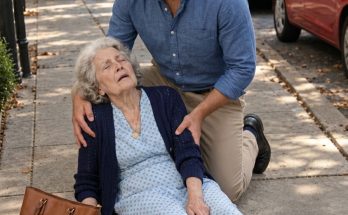
She had written about the day she collapsed.
She remembered the heat of the road and the strange sensation that her body was no longer following her instructions.
She remembered being frightened.
She remembered a man's voice telling her that help was coming.
She couldn't remember my face clearly until she saw me again in her kitchen.
Her letter did not call me a hero.
It thanked me for staying.
Then it said something I read twice.
I spent years teaching older people to accept help without shame. When it was my turn, I discovered I was terrible at it.
I folded the paper.
For months I had thought about what I lost that morning.
My job.
My sense of security.
My confidence in people I worked beside.
But Eleanor had also been facing a loss of control.
She hadn't wanted to need a stranger.
She hadn't chosen a frightening medical emergency.
We had been thrown into the same moment from opposite directions.
I called her.
“Your letter was beautiful.”
“I was worried it was too sentimental.”
“Only a little.”
She chuckled.
“Good. I haven't lost all my dignity.”
A few weeks later, Melissa and the girls joined us for lunch.
Eleanor asked Nora about her science project.
She listened to June explain the rules of a game nobody else understood.
Then she told the girls about the first time she had learned to drive.
She had stalled her father's truck in the middle of an intersection.
June was delighted.
“Dad stalls the lawn mower.”
“June,” I said.
Everyone laughed.
That afternoon, Eleanor became more than the woman from the highway.
She became someone our family knew.
Eleanor sometimes grew tired during our visits.
At first, I worried whenever she stopped speaking to catch her breath.
She would wave me off and say her cardiologist had given her a plan.
I learned to ask whether she wanted assistance instead of assuming I knew what she needed.
One afternoon, I arrived with groceries and found her sorting old photographs.
She had worked at the nutrition program for nearly twenty-five years.
The pictures showed volunteers in aprons, delivery vans, and tables full of paper records.
“Why keep all of these?” I asked.
“Because people forget the work that happens before the celebration.”
She pointed to a photograph of a young woman loading boxes into a van.
“That's Ruth. She organized routes when our funding was cut.”
Another showed a man repairing a broken refrigerator.
“That's Allen. He saved us a fortune in food loss.”
Eleanor remembered everyone.
I wondered whether Gavin could name all the people who had stayed late preparing the presentation he blamed me for missing.
Then I stopped thinking about him.
Eleanor was telling me her story.
I listened.
She explained that the program nearly closed one winter because the cost of fuel rose unexpectedly.
They met with county officials and private donors.
They adjusted routes.
They asked for temporary help.
“No one person saved it,” she said.
“Not even you?”
“Especially not me.”
Her smile was tired but pleased.
That afternoon, I helped her label the photographs for a community archive.
It was slow work.
We wrote dates where she remembered them and left blanks where she didn't.
I resisted the urge to fill the blanks with guesses.
I was beginning to value saying I don't know.
When I got home, June asked why I spent time with Eleanor.
“Because she's our friend.”
“But you met her because she was sick.”
“That's how we met. It isn't all she is.”
June thought about it.
“Like how you got fired but you aren't only a fired person.”
I stared at her.
“Exactly.”
Children sometimes find the plainest words for things adults spend months trying to understand.
The next time we visited Eleanor, June brought a drawing of a bright green cardigan.
Eleanor pinned it to her refrigerator beside the appointment cards.
She said it made the kitchen look cheerful.
June asked whether she could draw the grocery van next.
Eleanor gave her a photograph to use as a reference.
Soon the refrigerator held both drawings.
The friendship had become ordinary enough to contain small projects and jokes.
That was what I wanted for all of us.
Click here to continue reading: PART 14: A Year of Ordinary Tuesdays After the Morning Everything Went Wrong
The Eight-Thirty Presentation I Missed Because a Stranger Collapsed Beside the Highway
Part 13 of 16