The first package was heavier than I expected.
I balanced the blue ceramic bowl on my knees and read the card again.
My darling Claire.
I hope I'll be there.
But if I'm not.
Seven days earlier, I had stood beside Mom's hospital bed and listened to the steady, ordinary sounds of the machines.
I'd asked her whether she wanted the curtains open.
She'd asked whether I'd remembered to eat lunch.
That was how our family worked.
Mom protected us from her worries, and Ben and I pretended we could protect her from everything else.
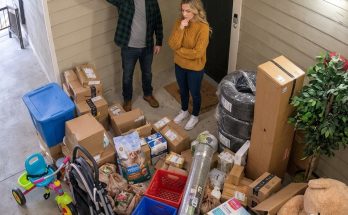
Now there were twenty-seven unopened packages in a hallway, and the words on that card made me wonder how much she had carried alone.
Ben sat beside me, one knee pressed against the threadbare runner.
“Maybe she was just being careful,” he said.
“Maybe.”
“You know how Mom was. She always planned Christmas in August.”
I nodded, although neither of us sounded convinced.
Mom's name was Evelyn Mercer.
She was seventy-four, and she had lived alone in apartment 4B since Dad died.
She disliked waste, kept rubber bands around old envelopes, and could make a pot of soup last three meals without making anyone feel they were eating leftovers.
A stack of packages didn't fit the woman we knew.
The hallway smelled of lemon cleaner.
Somewhere downstairs, a delivery cart rattled over tile.
Ordinary life was continuing while I sat on the floor holding something my mother had bought for a birthday she might not see.
“Let's get them inside,” Ben said.
He took out his phone.
“First I'll photograph the labels. If anything's wrong, we need a record.”
That sounded like my brother.
Ben worked in facilities maintenance for the school district.
When something broke, he wanted to know which part had failed, what it would cost, and who had the right tools.
I had spent most of the last week feeling helpless.
His practical voice was a relief.
We photographed every parcel without opening it.
There were twenty-eight in all.
A few had been delivered before Mom went into the hospital.
Most had arrived afterward.
Her name appeared on twenty-six labels.
Two were addressed to her apartment but carried someone else's name.
One was marked for delivery on a later date, although the courier had evidently brought it early.
Attached to a broad, flat box was a card in Mom's handwriting.
DO NOT OPEN THIS ONE FIRST.
Beneath that, in smaller letters, she'd written:
Please finish the others before you decide what I meant.
Ben held it up.
“Is this what you meant about a mysterious instruction?”
“I didn't see it until now.”
We looked at each other.
I felt irritated for a moment.
Mom had always made small surprises out of ordinary things.
She could turn a grocery bag into a treasure hunt with three folded clues.
I didn't want a treasure hunt from a woman we had just buried.
I wanted her in her kitchen.
I wanted her to tell Ben he was standing in the wrong place and to ask me whether my car needed gas.
Instead, we carried boxes through her doorway.
Her apartment was exactly as we'd left it after taking her to the hospital.
A green cardigan hung over the kitchen chair.
A crossword book lay open beside her glasses.
There was a grocery list held to the refrigerator by a magnet shaped like a strawberry.
Milk. Oats. Lemons.
Nothing about it looked like the home of someone expecting to die.
Ben put down the last box and stood still.
“Her slippers,” he said.
They were next to the sofa, toes pointed toward her favorite chair.
He pressed his lips together.
Then he turned away and asked where I wanted the parcels.
We put them in rows along the living-room wall, leaving the narrow walkway clear.
I wrote numbers on sticky notes so we could match each item to its delivery label.
We didn't plan to divide anything that day.
There would be paperwork, a lease to settle, and accounts to review.
For now, our job was only to find out what Mom had done.
The second parcel was small.
Inside was a set of sturdy gardening gloves and a packet of marigold seeds.
The envelope said: For Mrs. Alvarez downstairs.
I knew Mrs. Alvarez by sight.
She always carried a canvas shopping bag and complained lovingly about the building's elevator.
The note said Mom hoped her balcony would be full of yellow flowers again in spring.
Underneath the gloves was a receipt.
Mom had bought them six weeks earlier.
“Why would she order those to her own place?” Ben asked.
“Maybe she couldn't get downstairs to deliver them.”
We put the package aside.
The next one held a knitted baby blanket, pale green, with a card addressed to a young woman named Nia.
I recognized the pattern.
It was the same one Mom had worked on during our last Sunday visit.
She'd told me it was for a neighbor.
I'd been answering a work message and hadn't asked which neighbor.
A little label was sewn into one corner.
Made with love, Evelyn.
Ben traced the stitches with his thumb.
“She made this herself.”
The shipping box was from a craft store.
The blanket had been folded inside after the package arrived.
Under it were three skeins of yarn and a packet of wooden buttons.
We stopped treating the boxes as shopping deliveries and began treating them as messages.
A fourth contained two children's books, a small stuffed fox, and a card for someone called Oliver.
A fifth contained an inexpensive toolkit for a neighbor named Isaiah.
The handwritten notes were brief.
They weren't grand declarations.
Most referred to small things that had happened months earlier.
Thank you for fixing the loose railing.
Congratulations on the new baby.
You said you missed reading with your dad.
I could picture Mom writing each note at the kitchen table, using the good pen she kept in a chipped mug.
“Claire,” Ben said, “when was the last time we asked her about anyone in this building?”
I couldn't remember.
We called every Sunday.
We asked whether she was eating, sleeping, taking her medication, and keeping her appointments.
She asked us about our jobs and bills.
I knew almost nothing about the people who filled the rest of her week.
My phone rang.
It was my daughter, Sophie, checking whether we needed help.
She was twenty-three and lived an hour away.
I told her about the packages and the blue bowl.
She went quiet.
“Grandma told me she had something planned,” she said.
“What kind of plan?”
“She didn't say. She made me promise not to ruin a surprise.”
“When?”
“Before she went into the hospital. Maybe two weeks.”
I leaned against the counter.
“Did she tell you she knew she was dying?”
“No. Mom, she didn't say that.”
Sophie sounded shaken.
“Please don't think she lied to you. She just said there were some things she wanted finished.”
I looked at the card still resting beside the mixing bowl.
I thought of how Mom had smiled at us from her hospital pillow.
We were so busy measuring her strength that we'd forgotten she had thoughts of her own.
After the call, Ben found the address book beside the telephone.
Several names from the parcels were written inside.
Some had apartment numbers.
Others had phone numbers and little marks beside them.
He opened it to a page marked with a blue paper clip.
At the top Mom had written a single sentence.
Start with the people, not the things.
Ben read it aloud.
I felt an odd mixture of tenderness and annoyance.
Even now, she was telling us how to do a job.
I opened the apartment door.
Before Rosa arrived, I had also found a stack of grocery coupons tucked beneath Mom's telephone.
She'd clipped them by category and written expiration dates in pencil.
Beside the coupons was a small stack of thank-you cards still sealed in plastic.
For years I had teased her about buying stationery when she already owned drawers full of it.
Now I wondered whose names she had intended to write.
I thought of the last afternoon we'd spent together before the hospital.
Mom had asked whether I could take her to the pharmacy.
I said I had a meeting and offered to arrange a delivery.
She told me that was fine.
I remembered being pleased that she hadn't argued.
Only now did I wonder whether she'd wanted the car ride more than the medication.
The thought was painful, but I couldn't honestly claim to know.
She might simply have wanted her prescription filled.
I had to stop turning every ordinary exchange into a missed warning.
I picked up one of the blank cards.
The inside was empty.
If Mom had used it, she might have written something funny about returning a casserole dish or fixing a loose hinge.
She might have kept it for Christmas.
It would have been easy to invent a dramatic intention for every object on her table.
Ben saw me looking at the cards.
“Don't start reading mysteries into the rubber bands,” he said.
I laughed in spite of myself.
“You're right.”
We returned the cards to the drawer.
Whatever Mom had planned, the words she had actually written mattered more than the words we could imagine for her.
Across the hallway, a woman was struggling with a grocery trolley and a folding cane.
She stopped when she saw us surrounded by boxes.
“Oh,” she said softly. “You must be Evelyn's children.”
I nodded.
“I'm Claire. This is Ben.”
The woman put one hand on her chest.
“My name's Rosa Alvarez.”
Her eyes filled.
“Your mother told me she had a little something for my balcony. I was going to tell her not to fuss.”
I picked up the gloves and seeds.
“Are these for you?”
Rosa saw the envelope.
She covered her mouth.
Then she looked past me into the apartment.
“I wish she'd let you know,” she whispered.
“Let us know what?” Ben asked.
Rosa hesitated.
“About how she spent her Thursdays.”
I looked toward the row of unopened packages.
Until that moment, I had believed we were discovering presents.
Now I understood that we were only beginning to discover our mother.
Click here to continue reading: PART 2: A Neighbor Explains the Thursdays Our Mother Never Told Us Much About
The Blue Bowl That Made Me Understand Why Mom Had Ordered Twenty-Eight Packages
Part 1 of 12