Renee didn’t answer right away.
I could hear her breathing change.
Quick, then slow, then quick again, like she was trying to figure out which version of herself to use on me.
“You recorded us,” she finally said. “In my mother’s house. That’s illegal.”
“It’s a one-party consent state,” I said. “I checked before hitting record.”
Silence.
“You checked,” she repeated, like the words tasted wrong.
“I’ve had time to think about a lot of things tonight.”
“This isn’t you, Maren. You don’t do this. You smile and you fix things and you go home. That’s the deal.”
There it was.
The deal.
Nobody had ever said it out loud to me before, not like that, not as a thing with terms.
“What deal, Renee?”
“You know what I mean.”
“I don’t think I do. Say it.”
A long pause. I could hear a door close on her end, muffled voices behind it.
“You’re the one who handles things,” Renee said, quieter now. “You always have been. Nobody asked you to record a private conversation and turn it into some kind of — evidence.”
“I didn’t turn anything into evidence. I put pictures of six chairs in a box. I put copies of bank transfers in a box. Those already existed, Renee. I didn’t invent them tonight.”
“So this was planned. You’ve been planning this.”
“I’ve been keeping records for years. That’s different from planning something.”
She laughed, short and humorless. “Listen to yourself. Keeping records. Like we’re a company you’re auditing.”
“Maybe that’s exactly what I should have been doing from the start.”
Another silence, longer this time.
Then, quieter, almost pleading: “Mom didn’t mean it like that. About the chairs. You know how she gets when she’s stressed about hosting.”
“She meant it enough to leave six chairs against a wall and tell you to leave it alone when I came back inside.”
“That’s not — ”
“I heard you too, Renee. I heard exactly what you said. ‘She needs to remember who’s actually family here.’ I have that on a recording that’s sitting in a drawer at your mother’s house right now.”
The line went dead quiet, the kind of quiet that has weight to it.
“What do you want,” she said finally. Not a question. Flat.
“I want you to open the folder in the morning, with your mother, when everyone’s sober and rested and not performing for a camera. I want you to actually read what’s in it. That’s all I want tonight.”
“And the money? The — the chairs thing, what you said on the phone. About us paying for our own chairs starting tomorrow.”
“It means what it sounds like.”
“You can’t just — we have things arranged. Mom’s kitchen. Tyler’s car payment. You know Tyler’s car payment comes out of what you send every month, Maren, he’s not going to make it if that stops.”
“I know exactly what comes out of what I send. I have the transfer history for every single one of them.”
“So you’re punishing us.”
“I’m stopping.”
“Same thing, from where we’re sitting.”
I looked at my reflection again in the dark window over the sink. My own face looked strange to me, older, steadier than I felt.
“No,” I said. “It’s not the same thing. Punishing is if I called Tyler’s bank and asked them to freeze his account. Stopping is if I stop paying for a family I’m not actually part of the way I thought I was.”
Renee didn’t answer.
I heard footsteps behind me. Daniel, in the doorway, hair flattened from the pillow, blinking against the kitchen light.
“Who’s that,” he mouthed.
I held up a finger. Renee was still on the line, saying something about how I was going to regret making this a whole production, how families don’t do this to each other, how I’d been raised different, apparently, if I thought this was normal.
“Goodnight, Renee,” I said, and hung up before she could finish the sentence.
The kitchen went silent except for the hum of the refrigerator.
Daniel stood there a second, taking in my face, the phone still in my hand, the counter, the way I was gripping the edge of it like it might tilt.
“That was Renee,” he said. Not a question.
“Yes.”
“At — ” he checked the microwave clock ” — eleven forty at night.”
“Yes.”
“What happened at the party. You said it was fine when you texted me from the road. You said you’d tell me when you got home and then you just — put the kids to bed and went quiet.”
I hadn’t lied to him, exactly. I’d just been buying myself three hours to think.
“Sit down,” I said.
He sat.
I told him about the chairs. The concrete strip by the flower bed. Noah’s plate balanced on his knee, trying so hard not to spill anything that his hands were shaking a little by the end. Lily standing there with her plate against her chest like she already knew better than to ask.
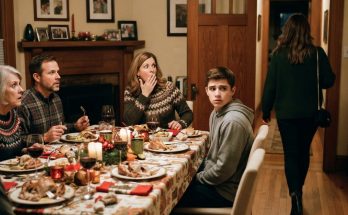
I told him about the six folding chairs in the dining room, untouched, stacked against the wall.
I told him what I heard through the storage room door.
His face changed with each piece, moving from confusion to something harder, something I hadn’t seen on him in a long time — not since his father died and Carol had leaned on him so hard, so fast, that he’d missed two weeks of work just managing her.
“She said that,” he said. “About remembering who’s family.”
“Your mother said it too. Different words. Same idea.”
He put his head in his hands for a second. Not dramatic. Just tired, the way a person gets tired when a picture they’d built carefully over years develops a crack they can’t unsee.
“What did you leave them,” he asked. “You said you left something.”
I told him about the box. The photos. The printed transfers — seven years of them, roof repair, hospital bills, Tyler’s tuition, the months I covered Renee’s rent after her divorce, all of it, dated and totaled.
The recording.
The note.
He was quiet for a long moment.
“You’ve been keeping all of that,” he said. “This whole time.”
“I’m a finance manager, Daniel. I keep records. It’s what I do for a living. I didn’t think I was building a case. I just — never deleted anything.”
“And tonight you decided to use it.”
“Tonight I decided I was done being the family’s emergency fund and being told to sit on the ground about it.”
He didn’t defend his mother, at least — he didn’t reach for her side automatically, the way I half expected him to.
But he didn’t fully land on mine either.
“I need to call her,” he said. “Not tonight. Tomorrow. I need to hear it from her side too.”
“That’s fair,” I said, and meant it, even though something in my chest tightened at the words her side, like there could be a version of six empty chairs that made sense from some angle I hadn’t considered.
He reached across the counter and took my hand. His was cold.
“Noah said something in the car,” I told him. “He said, ‘we’re used to sitting somewhere else, Mom.’ Like it’s a fact about the world. Like it’s just how things are for him.”
Daniel didn’t say anything to that.
We went to bed without resolving it, the two of us lying there in the dark, both of us awake, both of us pretending not to be, the phone on the nightstand lighting up twice more before midnight with Carol’s name on the screen.
I didn’t answer either time.
Around one, Daniel spoke into the dark, his voice low, like he wasn’t sure he wanted me to hear it.
“When I was a kid,” he said, “there was a Thanksgiving where we ran out of chairs too. I was nine. My dad gave me his seat and stood behind me the whole meal with a plate in his hand. I thought that was just what dads did.”
“That’s different,” I said. “That was your father choosing to stand. Nobody chose for Noah. Nobody even asked him.”
“I know. I’m not saying it’s the same. I’m saying I think I grew up believing kids were supposed to absorb whatever was left over, and I never once questioned it, because in my house it looked like sacrifice instead of what it actually was.”
“What was it actually?”
He didn’t answer for a long moment. “I don’t know yet. I need to think about it without you watching my face while I do.”
I let that sit. It felt like the most honest thing he’d said all night, more honest than the earlier promise to hear his mother’s side.
“I’m not asking you to pick a side tonight,” I said. “I’m asking you to remember what you saw with your own eyes the last time you were at your mother’s house and there weren’t enough chairs. Not what she tells you tomorrow. What you actually saw.”
“I remember,” he said. “I’ve been trying not to, but I remember.”
Somewhere close to two, Lily’s door creaked, small footsteps in the hallway, and she appeared in our doorway in her nightgown, hair static-flat on one side.
“I heard the phone,” she said. “Is Grandma okay?”
“Grandma’s fine, baby,” I said, sitting up. “Why aren’t you asleep?”
“I keep thinking about the chairs,” she said, matter-of-fact, the way children sometimes deliver the hardest sentences without knowing they’re heavy. “I counted them before we left. There were six against the wall. I counted twice because I thought I was wrong the first time.”
Daniel went very still beside me.
“You don’t have to think about that anymore tonight,” I told her. “That’s my job to think about now, not yours.”
“Okay,” she said, though she didn’t sound entirely convinced, and let me walk her back to bed, tuck the blanket under her chin the way she still liked even though she said she was too old for it.
When I came back, Daniel was sitting up against the headboard, staring at nothing.
“Six,” he said. “She counted them twice.”
“She’s nine. She shouldn’t have had to count them once.”
He didn’t argue. He just reached over, turned off the lamp, and in the dark I heard him exhale, long and slow, like something in him had finally, quietly, given way.