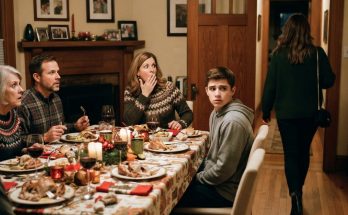
It’s been eight months since the accident.
Owen and Theo are walking now, badly, gloriously, holding onto furniture and each other and occasionally our knees, announcing every wobbling step like it deserves applause, which, I’ve decided, it does.
Ethan is back to his 7:30 mornings and his 5:15 evenings, mostly, though some days run later now for reasons I always know about, because he texts me the real reason, every time, even the boring ones. Stuck behind an accident on Grant. Ran into Dave from accounting, he wouldn’t stop talking. Nothing dramatic. Nothing hidden. Just the small, unglamorous honesty of a marriage doing the work of staying a marriage.
His scar has faded to a thin pale line low on his throat, visible only if you know exactly where to look, which I do, because some nights I still find myself resting my hand there before we fall asleep, just to feel the steady pulse underneath it, proof that whatever else this year took from us, it didn’t take that.
His last bloodwork came back exactly where Dr. Alvarez wants it. No evidence of recurrence. A follow-up ultrasound scheduled for the fall, which we’ll go to together, the way we go to everything together now — not because we’re afraid, but because that’s simply what we decided this looks like going forward.
We still see Dr. Renner once a month. Not because we’re in crisis anymore. Because we learned, the hard way, what happens when two people who thought they shared everything discover a five-month gap they never knew existed, and we didn’t want to trust our own assumptions about closeness again without checking them, occasionally, against an outside eye.
Laura Bishop sends a card every December, which always makes Ethan laugh — an estate attorney who apparently does holiday cards — usually with some dry line about hoping the Trust is having a boring year, financially speaking, which we’ve come to understand is the best possible thing an estate attorney can wish you.
Dana still asks, every few months, how we’re really doing, and I’ve stopped giving her the short answer.
“Some days I still feel it,” I told her last week, sitting on her back porch while the boys chased her dog across the yard. “Not suspicion, exactly. More like an instinct to double-check things I never used to double-check. I glance at his calendar sometimes. Not because I think there’s something there. Just to be sure.”
“Does he know you do that?” she asked.
“He does,” I said. “I told him, back in one of our counseling sessions. He said he understood, and that I could check as long as I needed to, and that eventually I’d probably stop needing to, and he’d rather I check than carry it silently and let it curdle into something else.”
“That’s a healthy answer,” Dana said, sounding faintly surprised.
“We’ve had a lot of practice lately,” I said, “at giving each other healthy answers instead of easy ones.”
Priya still watches the boys some mornings, and last month, when I finally told her the whole story over coffee at her kitchen table, she was quiet for a moment before she said something I’ve thought about often since.
“You know what strikes me,” she said, “isn’t that he hid it. People hide things when they’re scared, that’s not shocking. What strikes me is that he built you an entire safety net without telling you, instead of just telling you and building it together. That’s such a specific kind of love and such a specific kind of mistake, both at once.”
I think that’s the truest thing anyone has said about this whole year.
We took the boys to the beach a few weeks ago, their first real trip beyond the backyard, both of them shrieking at the cold water lapping over their toes, Ethan holding Theo up over one wave while I held Owen over the next, the four of us soaked and laughing and entirely, uncomplicatedly happy in a way that felt earned rather than given.
Watching him wade out of the surf that afternoon, scar barely visible, sunlight on his face, I thought about how close I’d come, eight months earlier, to imagining an entirely different version of this story — a stranger, a second life, a marriage quietly ending in a hospital hallway instead of slowly rebuilding on one. I thought about how easy it would have been to let that first, worst fear calcify into certainty before I ever picked up the phone to Laura Bishop’s office. I’m grateful, now, for every slow, careful, methodical step I took instead — the calls, the folders, the questions asked one at a time instead of all at once in anger. It didn’t make the truth painless. But it meant that when the truth finally arrived, I was ready to hear all of it, rather than only the parts that confirmed what I’d already decided to believe.
Last week, I was cleaning out the front closet and found the plastic bag.
The hospital one. The clear one they’d handed me that first afternoon, still tucked in the pocket of the coat I’d been wearing, forgotten there for months, the way small terrible objects sometimes are once the terror around them fades.
I sat down on the closet floor and opened it.
His old cracked phone, replaced months ago, the screen a spiderweb of fracture lines. His wallet, the same one, still in daily use, the leather softer now with wear. His wedding ring, which he’d worn home from the hospital the moment his hand was healed enough to fit it again.
I turned the bag over in my hands, the way I had that day in the hallway, except this time nothing shifted loose. No card slid free from underneath the wallet. No small yellow flag with three words that would upend everything I thought I understood about the man I’d married.
Just the everyday pieces of Ethan’s life. The ones I’d seen a thousand times before, and have seen a thousand times since.
I thought about how certain I’d been, walking down that hallway eight months ago, that I knew every corner of our marriage. Phone passwords. Bank accounts. Schedules. Appointments. I would have told anyone who asked that there was nothing important in Ethan’s life that I didn’t already know.
I was wrong about that, and finding out I was wrong nearly broke something between us that had taken nine years to build.
But I think, now, sitting on the closet floor with an empty plastic bag in my lap, that the version of our marriage we have now is actually stronger for having been tested — not because the secrecy was good, it wasn’t, and I still feel its cost some days, in small unexpected moments, a flicker of old suspicion that fades faster now than it used to but hasn’t entirely gone. It’s stronger because we know, now, in a way we didn’t before, that sharing everything isn’t a fact you get to assume just because you’ve shared a lot. It’s a practice. Something you keep choosing, actively, especially in the moments when the easier thing would be to carry the hard part alone and call it love.
Ethan found me there on the closet floor a few minutes later, Theo on his hip, asking if I’d seen his other shoe.
He saw the bag in my lap and went quiet.
“I was cleaning out the coat closet,” I said. “Found this in my old coat pocket. Guess I never actually threw it out.”
He sat down next to me, Theo squirming to get down and toddle off toward his brother, and looked at the bag for a long moment.
“That was a bad day,” he said finally.
“It was,” I agreed. “It was also, weirdly, the day that ended up teaching us the most.”
“I’d still take back not telling you sooner, if I could,” he said. “I don’t want you to think I look back on any of it fondly.”
“I know,” I said. “I don’t either. But I don’t regret the version of us that came after it. That part I’d keep.”
He put his arm around me, careful of nothing now, no splint, no fear, just an ordinary Tuesday evening with two toddlers shrieking happily somewhere down the hall.
I looked at the bag one more time before I finally put it in the recycling, the wallet and the ring and the old broken phone set aside to keep, the plastic itself no longer needed, its job long finished.
Some marriages get tested by the things people assume — an affair, a lie, a stranger’s name where it shouldn’t be. Ours got tested by something smaller and, in its own way, harder to see coming: a good man, frightened, trying to carry an unbearable thing alone so the people he loved wouldn’t have to feel its weight.
He was wrong to do it that way. I still believe that, plainly, without softening it.
But I understand, now, exactly what he was protecting, and exactly what it cost him to try to do it without me.
We share everything now. Not because we always did — we didn’t, not really, not all the way — but because we learned, the hardest way two people can learn something, that everything is the only version of sharing that actually holds.
The End