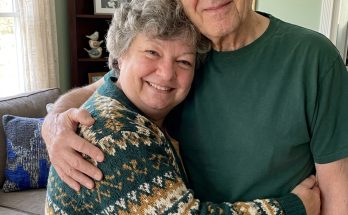
Mom turned seventy.
I flew in from London for her birthday.
Short contract. Three weeks.
Nothing like Dubai.
Still, she complained I traveled too much.
Some things survived.
I rented a car.
Drove to her house.
No surprise this time.
She knew I was coming.
That mattered.
The front garden was overgrown with basil.
Her fault.
The door opened before I knocked.
Mom stood there.
Yellow dress. Gray hair. Bare feet.
She smiled.
“Can I help you?”
I stared.
Then she added:
“We don’t buy anything at the door.”
I laughed so hard I had to lean against the wall.
She laughed too.
Then hugged me.
Humor had completed the transformation.
Julian’s line no longer belonged to him.
Inside, Khloe was setting the table.
Samuel sliced fruit.
No one wore a robe.
No scotch.
No clients.
No performance.
Mom’s house. Her guests. Her rules.
We ate.
After cake, Mom brought out a small box.
“For you.”
Inside was the old gate latch.
The one I had saved from the Austin house.
I stared.
“How did you get this?”
“You left it in my garage.”
Of course.
“What am I supposed to do with it?”
“Remember.”
I looked at her.
“Remember what?”
She sat beside me.
“That locks are not what saved me.”
I went still.
She continued.
“You did.”
I shook my head.
“No.”
“Yes.”
“Mom—”
She raised one finger.
“Let me finish.”
So I did.
“You came home.”
“Yes.”
“You believed me.”
Yes.
“You didn’t tell me I was foolish.”
My throat tightened.
“You changed everything.”
I started to answer.
Then stopped.
Because she was right about part of it.
But not all.
“I changed the locks.”
She smiled.
“Yes.”
“You changed the rest.”
She looked down.
“What?”
“You went to therapy.”
She listened.
“You signed the fraud report.”
“You chose the new house.”
“You made Khloe wait.”
“You decided what help looked like.”
Her eyes filled.
“That was you.”
We sat quietly.
Then Khloe joined us.
“What are we crying about?”
“Locks.”
She rolled her eyes.
“Of course.”
Mom showed her the latch.
Khloe’s expression changed.
“I’m sorry.”
Mom touched her hand.
“I know.”
No longer an open wound.
A scar.
Different.
We walked outside.
Mom’s lemon tree had finally produced fruit.
Three lemons.
Tiny. Proud.
She showed them off like grandchildren.
Khloe teased her.
Mom threatened to cut her from the will.
We all froze.
Then Mom burst out laughing.
“So not funny?” she asked.
“Too soon forever,” Khloe said.
We laughed.
Even that.
Because power had changed.
The will was no longer a weapon.
The house no longer a prize.
Money no longer a secret language.
That night, after everyone left, I stayed on the porch with Mom.
Warm air. Quiet street.
She asked about London. Work. Whether I was lonely.
Real questions.
Not management.
Then she said:
“I need to tell you something.”
I waited.
“When you were overseas, I thought being a good mother meant not bothering you.”
I nodded.
“I was wrong.”
“Yes.”
She looked at me.
“And when Khloe needed me, I thought being a good mother meant letting her stay no matter what.”
I listened.
“Also wrong.”
“Yes.”
She smiled.
“I’m getting very wise.”
“Expensively.”
She laughed.
Then serious.
“Do you know what I think now?”
“What?”
“A good mother tells the truth before the house catches fire.”
I smiled.
“Metaphorically.”
“Preferably.”
We sat.
Then she took my hand.
“I don’t need you to rescue me anymore.”
That sentence should have hurt.
It did not.
It felt like success.
“Good.”
She squeezed my fingers.
“But I still need you.”
Different.
Better.
I understood.
Years earlier, I thought care meant providing enough money that danger could not reach someone.
Then I learned money does not create boundaries by itself.
Locks do not create dignity.
Legal ownership does not create safety unless the person inside is allowed to have a voice.
Mom stood.
Opened the front door.
Then paused.
Looked back at me.
“This is my home.”
I smiled.
“Yes.”
She continued.
“And you are always welcome.”
Not entitled.
Welcome.
The distinction held everything.
I stepped inside.
The door closed.
No fear.
No maid.
No one kneeling.
Before I left for London again, Mom handed me a spare key to her new house.
I took it.
Then gave it back.
She frowned.
“What?”
“I already have the code.”
“So?”
“I don’t need both.”
She studied me.
Then laughed.
“Six years ago you would have made three copies.”
Probably.
Backup keys.
Emergency folders.
Control disguised as preparedness.
We both recognized it now.
“I trust you to call me if you need me.”
Mom nodded.
“And I trust you to come if I do.”
“Yes.”
That balance had taken years.
Dependence says you cannot manage without me.
Distance says you should manage without me.
Healthy love sits somewhere between.
I am available.
You are capable.
Both.
When Mom later joked at the birthday door about not buying anything, the humor worked because the original danger no longer controlled us. Julian’s words had once reduced her to labor and me to a stranger.
Now Mom used the same rhythm to welcome me.
That was reclamation in its gentlest form.
No speech.
Just laughter where humiliation used to live.
The last time I saw the old Austin house, I drove past without planning to. A different family lived there. Bicycles by the garage. Chalk on the driveway.
For a second, I wanted to stop.
Then I kept driving.
The house no longer needed to hold our story. It had become someone else's ordinary life.
That surprised me with relief.
We had once treated the property as if it were the center of everything: protection, betrayal, money, family. In the end, it was a building. The real repair traveled with us.
Mom's ability to choose. Khloe's accountability. My willingness to stay present without controlling.
Those things did not require six hundred thousand dollars of brick to survive.
I eventually mounted the old gate latch on a small piece of wood in my office. Not prominently. It sits behind a row of books where most people never notice it.
When they do, they ask why I kept rusty hardware.
I usually say, "Long story."
The real answer is that it reminds me of the difference between access and belonging. Julian had access to the house and no respect for what it meant. I had legal ownership and still failed to see what was happening inside. Mom had the weakest formal power and was the person the home was supposed to protect.
A lock only tells you who can open a door. It cannot tell you who is safe once the door closes.
Years later, Khloe asked what I would have done if Julian had never been caught moving the safe.
I thought.
"Kept going."
The legal process already had enough evidence. The safe accelerated things, but it did not create the truth.
That mattered to me because stories often hinge on one dramatic object. Real repair rarely does.
We had bank records, Mom's testimony, access changes, the notary note, messages, and years of behavior.
No single discovery saved us.
Like recovery, accountability was cumulative. One fact supporting another until denial had nowhere comfortable left to stand.
Just home.
The End
Read more original stories on Feel Every Story.