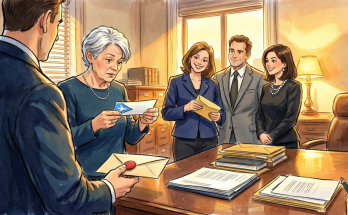
Mark brought the watch to our house. No designer coat. No attorney.
Just jeans and a tired face. He placed the watch on the table. Arthur’s old stainless-steel watch. Scratched.
Ordinary. On the back, almost too faint to see: Time is what you gave me least.
Mark stared at it.
“Did Dad do this recently?”
Claire shook her head.
“I don’t know.”
Sarah did. The engraving receipt was twelve years old. Arthur had added it after Mark missed his third planned visit in one year. Mark sat down.
“He wore this every day.”
“Yes,” Claire said.
“I never noticed.”
No one answered. He looked at me.
“You knew about the engraving?”
“No.”
“Convenient.”
The old suspicion surfaced. Then Mark stopped himself.
“Sorry.”
That was new. He rubbed his face.
“I keep looking for someone to blame for how this feels.”
Claire sat opposite him.
“How does it feel?”
“Like Dad waited until death to tell me I failed.”
I understood. The ledger did that to all of us. I said:
“He wrote while he was alive.”
“That’s not the same as telling me.”
“No.”
Mark looked surprised I agreed. Arthur had avoided hard conversations too. That mattered.
“He should have told you.”
Claire stared at me. I continued.
“He told his ledger. He told Sarah. He told his will. That’s not the same as telling you.”
Mark’s eyes filled.
“Thank you.”
Not absolution. Accuracy. Arthur’s silence had consequences too.
Mark said:
“I would have changed.”
Maybe. Maybe not. We did not argue.
Claire asked:
“Do you want to now?”
He looked at her.
“Change?”
“Yes.”
Mark laughed weakly.
“Dad’s dead.”
“There are still people.”
That line came from Tom, translated through me. Mark called Brenda that afternoon. Then Kevin. Not to discuss money.
He invited them to dinner. Our house. I almost objected.
Claire said yes before I could. Family meeting. No Sarah.
No documents. No estate agenda. Just dinner.
Brenda brought casserole. Kevin brought beer. Mark brought nothing.
He apologized. Then laughed at himself.
“I can go buy something.”
Claire said:
“Sit down.”
We ate. Awkwardly. The first twenty minutes involved weather, traffic, and complaints about grocery prices. Then Kevin mentioned Arthur’s chair. Brenda asked for a picture.
He showed her. She cried. Mark looked at the watch.
Then said:
“I’m sorry.”
No one knew who he meant.
“All of you.”
He swallowed.
“I acted like Dad’s will stole something from me.”
Claire looked at him.
“It hurt.”
“I know.”
“I mean being left less.”
“Yes.”
Mark nodded.
“I kept thinking less money meant less love.”
Kevin laughed once.
“Dad would hate that.”
“Probably.”
Brenda said:
“I thought the thermos meant he remembered me.”
Claire looked at her.
“He did remember you.”
“I know.”
She touched the dented thermos she had brought with her.
“He also remembered that I didn’t come.”
No one rescued her. Good. We talked about Arthur.
Not the estate. Real stories. The time he tried to grill in snow. The summer he convinced Noah that squirrels understood baseball.
His hatred of mayonnaise. The way he turned the radio louder whenever Mark called during a game. Mark laughed harder than anyone. Then suddenly cried.
No warning. He covered his face. Claire moved toward him.
Stopped. Waited. Mark lowered his hands.
“I wasted so much time.”
There was no answer. Time is what you gave me least. Arthur’s engraving had already answered. Kevin said:
“So don’t waste more.”
Simple. Dinner lasted four hours. No miracle reconciliation.
Mark still believed the will was emotionally harsh. Claire still resented years of absence. Brenda still defended some choices. Kevin still made jokes when uncomfortable. I still disliked Mark more than I wanted to admit. But we stayed.
That mattered. Before leaving, Mark handed Claire Arthur’s watch.
“What?”
“It belongs to me.”
“Yes.”
“I know.”
He smiled sadly.
“I want you to keep it for a while.”
Claire shook her head.
“No.”
Mark looked hurt. Then she explained.
“Dad chose it for you.”
She closed his fingers around it.
“Keep what he gave you.”
Mark looked at the watch. Then put it on. Too loose.
Arthur’s wrist had been thicker once. Mark wore it anyway. At the door, he turned to me.
“You keeping the inheritance?”
“Yes.”
First time I said it without hesitation. He nodded.
“Good.”
I stared. He smiled faintly.
“Dad would be furious if I talked you out of it.”
Probably. Then Mark said:
“I want to do something with my hundred thousand.”
“What?”
“I don’t know yet.”
I almost offered advice. Stopped. His money.
His decision. Arthur’s lesson was spreading in quiet ways. A week later, Mark called again. He had decided.
Not a donation. Not a flashy memorial. He wanted to pay back the eighteen-thousand-dollar loan Arthur had forgiven.
Not to the estate. To the trades foundation. I told him:
“You don’t owe it.”
“I know.”
“Then why?”
“Because I want to.”
That was different. I gave him Marisol’s number. No ceremony.
No family announcement. Mark asked that the donation remain anonymous. Arthur would have approved.
The first family dinner after Mark’s donation felt different. No one mentioned the foundation. That was how I knew the gift was truly his. If he had needed us to praise it, he would have raised the subject. He didn’t.
Instead, Mark asked Noah about landscaping equipment. Brenda asked Lily about a concert. Kevin complained about his roof. Normal. At dessert, Claire brought out Arthur’s old recipe box by mistake. It had belonged to Evelyn first.
Everyone went quiet. Then Brenda laughed.
“Are we going to fight over index cards now?”
The tension broke. Claire opened the box. Recipes.
Notes. A card in Arthur’s handwriting: Chili. Too much cumin last time.
Kevin said:
“Still too much cumin.”
Mark smiled. For years, family gatherings after Arthur moved in had contained an invisible question. Who should be doing more? Who should take him for a weekend? Who pays what?
Who visits? Now Arthur was gone, and the question had changed. What do we do with what he left us? Not just money.
Habits. Resentments. Stories.
The dinner became easier once no one tried to answer everything at once. Mark stayed late to help wash dishes. I noticed. Said nothing.
Claire noticed too. After he left, she whispered:
“Dad would write that down.”
“Yes.”
Then I corrected myself.
“He might have missed it.”
Claire looked at me.
“What?”
“We keep acting like the ledger saw everything.”
She smiled slowly. That mattered. Arthur’s notebook was one man’s perspective.
Detailed. Honest. Still partial.
We could respect it without treating every line as final judgment. That helped Mark most. His worst years were recorded. His better years now had no Arthur to witness them. We had to witness each other instead.
At another family dinner, Mark arrived early. That alone was funny. Claire opened the door and looked at the clock.
“You’re forty minutes early.”
“I know.”
“Are you sick?”
He rolled his eyes. Then helped set the table. No announcement.
No performance. I watched him place forks. Arthur’s watch slid down his wrist. Still too loose.
Mark pushed it back. That tiny movement stayed with me. Time is what you gave me least. He was wearing the sentence while giving us time. No one praised him.
That was probably good. Change becomes more real when it stops needing witnesses. Later, Kevin arrived late.
Mark looked at the clock. We all waited. Then he laughed.
“Dad is definitely enjoying this.”
Kevin heard him from the hallway.
“What?”
“Nothing.”
The dinner continued. Ordinary. That ordinariness was what Arthur had wanted while alive and what the estate fight had almost destroyed after death.