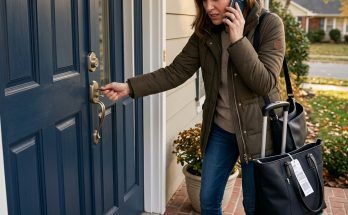
Helen ended up staying three nights, The furnace part took longer than promised., In the old days, she would have simply remained., This time, every morning she asked. “Another night okay?” Every morning, I decided. “Yes.”
That tiny exchange changed the feeling of the entire visit. She helped with breakfast. She stripped her own bed each morning because she did not know whether she would be back that night. She fed chickens once, Badly.
“You threw too much.”
“They looked hungry.”
“They always look hungry.”
“Relatable.” I laughed, On the second afternoon, rain kept us inside., Helen found the black notebook on the kitchen counter., She did not touch it. “Can I ask about something?”
“Yes.”
“Why do you write everything down?” I poured tea. “Samuel started it.” She looked surprised.
“I thought it was your thing.”
“No.” When we first bought the farm, Samuel kept a small ledger. Feed, Fuel, Repairs, Births, Deaths, Weather, He believed memory was useful but records were kinder., Kinder?, Helen frowned. “That was his word.”
I smiled. “He said memories change depending on who is angry.” Helen laughed. “That sounds like Samuel.”
After he died, I kept the habit., At first, it was only farm numbers., Then family promises crept in, Not because I was building a case., Because I was tired of hearing, “I thought I returned that.”, Or, “You never told me.”, Or, “It wasn’t that expensive.”, The notebook gave me somewhere to put reality. Helen traced the rim of her mug.
“Do I have a lot of pages?”
“Yes.” She winced. “Daniel?”
“More.” That cheered her up, I shook my head. “This isn’t a competition.”
“I know.” She grinned. “A little.” Then her face turned serious.
“Do you have pages about yourself?” The question surprised me. “What do you mean?”
“Things you promised and didn’t do.” I thought about it. “No.” Helen leaned back.
“That’s interesting.” I disliked the way she said it. “What?”
“You wrote down everyone else’s failures.”
“I wrote down what affected the farm.”
“Did none of yours affect it?” I looked toward the window, Rain streaked the glass, The pasture beyond was gray. “I suppose they did.” She did not push, That made the question harder to dismiss., That evening, I opened a fresh page., RUTH, I stared at my own name, Then I wrote, Said yes when I meant no, Complained privately instead of speaking directly, Expected people to notice things I hid., Used hosting to feel needed.
Avoided asking for help because I feared hearing no. Kept score without explaining the rules, That last one hurt, The notebook had protected me. It had also allowed me to tell myself I was communicating because I was documenting. Those were not the same thing, The next morning, Daniel called.
“Can I come by Saturday?” I almost said yes automatically, Then stopped. “What for?” He paused.
“I want to help with the roof estimate.”
“I already have an estimate.”
“Can I see it?”
“Why?”
“Because I know a contractor.” My first instinct was suspicion, Was he trying to take over?, Was he going to tell me I was being overcharged?, Was he going to turn help into control?, Then I noticed what he had actually done., He asked, “What time?” I said.
“Ten?”
“Okay.” Saturday, he arrived alone, At 10:02, Progress, He brought coffee. “For you.”
“Did you ask if I wanted coffee?” He froze, I laughed. “Daniel, I’m joking.” He exhaled.
“This is stressful.”
“Good.” He smiled despite himself, We sat at the kitchen table with the estimate., He read every line, Roof removal, Decking repairs, Underlayment, Shingles, Flashing, Labor, He whistled. “Twenty-two is actually not bad.”
“I know.” He looked up. “You checked?”
“I run a farm, Daniel.” His face flushed. “Right.” There it was, A small correction, Not a fight.
He asked whether I wanted him to call his contractor friend for a second opinion. I said yes, He made the call in front of me., No decisions, No promises on my behalf, No “Mom doesn’t understand.”, Just:. “My mother owns a farmhouse and has an estimate. She’d like a second opinion.”
I noticed every word, My mother, Owns, Would like, After the call, Daniel looked at me. “What?”
“Nothing.”
“You’re staring.”
“I’m appreciating your grammar.” He rolled his eyes, The second estimate came in two thousand lower with better materials., I hired that contractor, Daniel did not ask for credit, The roof work was scheduled for spring., Before he left, he noticed my new notebook page., His name was not on it, Mine was, He looked at me.
“What’s that?”
“Accountability.” He laughed. “For working adults?” I smiled.
“For all of us.” That night, I added one more line under my name. Let people help without assuming help means loss of control. I stared at it, Then closed the notebook, The farm was teaching me something I had not expected., Boundaries were not walls, Done well, they were gates, And gates could open, The new page with my own name stayed open for several days., Every time I passed the kitchen table, I saw it., RUTH.
The letters looked oddly formal, I added more, Refused help before anyone could disappoint me., Expected Daniel to remember what I never clearly scheduled., Made jokes instead of requests, Said “it’s fine” when it wasn’t, That last one looked uncomfortably familiar, Mom language, Wife language, Sister language. For years, “it’s fine” had done too much work.
Sometimes it meant fine, Sometimes it meant I am angry but don’t want conflict., Sometimes it meant I will do it myself., Sometimes it meant I want you to notice without being told., No wonder people stopped hearing the difference., I had trained them, That realization did not erase their responsibility., It clarified mine. The next time Daniel came over, I tried something new.
“The latch on the chicken run is sticking.” He looked toward it. “Want me to fix it?”
“Yes.”
“When?”
“Today, if you have time.”
“I do.” Simple, No test, No hidden expectation, He fixed it in twenty minutes, Then he came inside. “Anything else?”
“No.”
“You sure?”
“Yes.” He smiled. “You’re getting good at this.”
“So are you.” That night, I did not write the repair under PROMISES. There had been no broken promise, I wrote it under HELP ASKED FOR., Then:, Help given, It looked almost boring. Maybe healthy relationships were supposed to be boring more often. One evening, I read my own page aloud to Helen.
She did not tease me. When I finished, she said, “That sounds harder than writing everyone else’s names.” “It is.”
“Why?”
“Because I know all my excuses.” She smiled. “That’s usually the problem.” I added one final line, Do not confuse being needed with being loved., Then I closed the notebook.
That sentence stayed with me longer than any of the others. After that, I began noticing how often I reached for work whenever a conversation became uncomfortable. Sometimes I washed a dish that did not need washing. Sometimes I checked a latch I had already checked. Learning to stay in the room was another kind of work. END PART 7