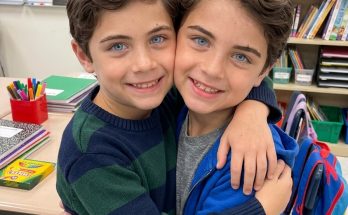
My son got into a fight at school because another boy refused to stop calling him his “brother.” But the second I saw that boy's face, every drop of blood in my body seemed to turn to ice.
Eight years earlier, I had been pregnant with twin boys.
I still remembered how their hearts sounded during an ultrasound.
Two quick, separate rhythms.
Mark stood beside the examination table with his hand on my ankle.
“Two quarterbacks,” he whispered.
I laughed so hard the technician had to ask me to stay still.
We had already chosen two names.
Cole and Oliver.
Then I went into labor far too soon.
The hospital lights blurred together.
There were voices around me, but I could not make sense of them.
Someone said the babies needed help breathing.
Someone else asked for an anesthesiologist.
When I woke two days later, there was one bassinet beside my bed.
One baby.
Cole lay beneath a striped blanket, small and red-faced.
I reached for him before I noticed the empty space on the other side of the room.
“Where's the other one?”
Mark lowered his head.
“He didn't survive.”
I remember the way he said it.
Not loudly.
Not with a dramatic sob.
He sounded like a man delivering news he had rehearsed.
I was too exhausted to hear anything except those three words.
I never saw Oliver's body.
There was no funeral I attended.
Mark said I was too weak, and he had handled the arrangements while I recovered.
When I asked where our son had been buried, Mark said there had been a private cremation.
He promised that one day, when I was stronger, we could choose a place for his ashes.
I asked again six months later.
Then again after Cole's first birthday.
Every time, Mark became quiet.
Eventually I stopped asking because each question turned our kitchen into a room neither of us could stand to occupy.
I poured everything I had into Cole.
He had his father's stubborn chin.
He had my gray eyes.
Beside his left eyebrow was a tiny, pale brown birthmark shaped like a comma.
Mark used to touch that mark with one fingertip while Cole slept.
Sometimes he would pull his hand away as though the skin had burned him.
I told myself he was grieving differently.
There were good years.
School concerts.
Rainy Saturdays with board games.
A seventh birthday cake that leaned so badly I had to hold it while Cole blew out the candles.
We were not a perfect family, but we knew how to make an ordinary afternoon feel safe.
At least, I believed we did.
Then Cole started talking about Stefan.
The first complaint came over dinner.
“There's this kid who says we're brothers.”
I passed him the potatoes.
“Maybe he means you're good friends.”
“We're not friends.”
Cole stabbed a carrot with his fork.
“He follows me around.”
Mark looked up so quickly that his glass scraped across the table.
“What's his name?”
“Stefan.”
I watched Mark's face.
“Do you know him?”
“No.”
His answer was too fast.
He reached for his phone and said he had to answer a work message.
Over the next few weeks, Cole grew angry.
Stefan had moved into his class after the autumn break.
He borrowed the same library books.
He knew Cole's favorite drawing game.
He kept saying they had the same father but different mothers.
“It's not funny,” Cole told me.
I agreed.
I emailed the teacher.
She replied that the boys had been separated during group work and that she was watching the situation.
I expected the teasing to fade.
Instead, the principal called on a Thursday afternoon.
“Cole was involved in another fight with Stefan. This one was serious. Please come in.”
I left my groceries on the checkout belt.
By the time I reached the school, my hands were damp around the steering wheel.
The principal, Mr. Bell, led me into his office.
Cole sat in a chair near the window.
His lower lip was swollen.
There was a bandage on one knuckle.
I crouched in front of him.
“Are you hurt anywhere else?”
He shook his head.
“Did you hit him?”
Cole looked past me.
“He wouldn't stop.”
“What wouldn't he stop doing?”
“Saying that thing.”
Then he pointed toward the far wall.
Another boy sat there with his hands folded tightly in his lap.
I turned.
And froze.
Same gray eyes.
Same narrow face.
Same small birthmark beside his left eyebrow.
Only the hair was different.
Cole's was light brown.
Stefan's was nearly black.
For a moment I saw Cole at four years old, sleeping under a blue quilt.
Then I saw a hospital room with one bassinet.
My knees softened.
I caught the edge of the desk.
“How is this possible?”
Mr. Bell pushed a chair toward me.
“Please sit down.”
I remained standing.
The other boy stared at me without blinking.
He looked frightened, but there was something else in his expression.
Recognition.
As though he had seen my face before.
“What's your name?” I asked, although I already knew.
“Stefan.”
“Stefan what?”
He glanced at the principal.
Mr. Bell answered gently.
“Let's wait until his parent arrives.”
Cole folded his arms.
“You see why he's being weird?”
His voice cracked on the last word.
I wanted to reach for him.
I also wanted to demand the boy's birthday, his hospital, the name of every adult who had ever cared for him.
But he was eight.
So was my son.
Neither child deserved to be questioned like a suspect.
I sat beside Cole instead.
“You aren't in trouble with me for being upset,” I said.
“But hitting someone still matters. We'll talk about that.”
He stared at the floor.
“Everybody thinks we're twins.”
There it was.
The word I had spent eight years avoiding.
Twins.
I felt a dull ache beneath my ribs.
Mr. Bell explained that the fight had begun at recess.
Stefan had shown Cole a photograph on a phone.
Cole had shoved it away.
Stefan had tried to show him again.
Then both boys pushed each other.
A staff member separated them before anyone was seriously injured.
“What photograph?” I asked.
Stefan pulled a folded piece of printer paper from his pocket.
It showed a man holding a toddler on a playground.
The man was Mark.
I knew his winter coat.
I knew the scar across his thumb.
I had bought the red gloves that hung out of his pocket.
My stomach turned.
“When was this taken?”
Stefan did not answer.
Mr. Bell placed a tissue box near me.
I didn't touch it.
I remembered one more thing from the hospital.
It was the last evening before the emergency delivery.
A nurse had asked whether we wanted a second set of tiny clothes brought in.
Mark said his mother had already bought them.
I pictured those clothes now.
Two pale yellow onesies with little boats printed across the front.
We had put them in a drawer beside the crib we planned to share between the boys for the first few months.
After Mark told me Oliver had died, he cleared that drawer without asking.
He said the sight of two sets of clothes would only upset me.
I had been grateful then.
I thought he was protecting me from a pain I could not bear.
Months later, I found one onesie at the back of a linen closet.
I held it for nearly an hour.
Mark came home and saw it in my hands.
He took it gently away.
“We should donate this,” he said.
I told him I wanted to keep it.
He said of course.
But when I looked for it again, the onesie was gone.
At the time, I believed he had made a mistake.
I told myself that grief sometimes made people careless.
Standing in the principal's office, looking at his face behind Nina's shoulder, I wondered what had really happened to that tiny piece of clothing.
It was unbearable to think he might have carried it to another home.
It was equally unbearable to think he had thrown it away.
The questions arrived faster than I could sort them.
Had he watched another child learn to walk?
Had he sat through another first-day-of-school assembly?
Had he bought two birthday presents every year and hidden one in his car?
I had never considered myself a suspicious person.
Mark had been the one who remembered to pay the water bill and check the tires before a long drive.
I had taken his competence for dependability.
When our friends spoke about marriage, I often said trust was a collection of ordinary habits.
I had believed ours was made of thousands of them.
Now I was looking at the same habits from the other side.
There had been late evenings when he said a client needed help.
There had been weekend errands he insisted on doing alone.
There had been a second phone number he called a business contact.
Maybe none of those things proved anything by itself.
But the man in the doorway knew why his own son had been looking for his twin.
And he had allowed Cole to walk into school every morning without warning him.
That frightened me almost as much as the original lie.
Because even now, faced with the chance to protect our children from a painful surprise, Mark had chosen silence.
The office door opened.
A woman hurried inside, her dark hair tied loosely behind her head.
She carried a worn handbag and looked as though she had run from the parking lot.
But I barely saw her.
A man stood behind her.
Mark.
My husband stopped when he saw me.
The color drained from his face.
Mr. Bell looked between us.
“Mr. Hayes, I wasn't aware you knew Cole's mother.”
Mark opened his mouth.
Nothing came out.
The woman turned toward him.
“You told me she knew.”
A silence settled over the room.
My son gripped my sleeve.
“Mom?”
I kept my voice steady for him.
“I'm here.”
Then I looked at Mark.
“Tell me why that child has a photograph of you.”
He stared at the floor.
And the woman beside him said something that made the whole room go still.
“He told me you had signed the papers.”
Click here to continue reading: PART 2: The Woman Beside My Husband Said I Had Given Away a Child I Believed Was Dead
The Boy in the Principal’s Office Had My Son’s Eyes and My Lost Baby’s Birthmark
Part 1 of 12