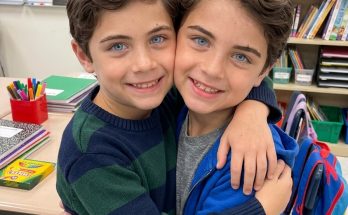
Cole's ninth birthday was approaching.
In previous years, Mark had organized a scavenger hunt in the backyard.
He would leave clues in cereal boxes and under flowerpots.
Cole always pretended the clues were too easy.
Then he would race through them with his face glowing.
This year, the birthday sat on my calendar like a question.
It was Stefan's birthday too.
Two boys had been born on the same day.
Two boys had celebrated separately for eight years.
I could not decide what a ninth birthday should look like.
Dr. Shaw suggested asking each child what he wanted without making a joint party the symbol of family unity.
Cole chose miniature golf with two friends.
Stefan wanted a small soccer party at a community center.
Nina called me with the details.
“He asked if you could come,” she said.
My chest tightened.
“Did you tell him he had to invite me?”
“No. He asked himself.”
“Then I'd like to be there.”
I bought Stefan a sketchbook and a set of colored markers.
Nina said he liked drawing vehicles and neighborhood maps.
I wrote a short card.
“Happy ninth birthday. I'm glad I'm getting to know you. Mara.”
I considered adding Love.
I loved him already, in the fierce complicated way a mother can love a child she has never had the chance to raise.
But I didn't want the card to ask anything in return.
I left it as it was.
At Cole's miniature-golf outing, his friends argued over who had cheated on the windmill hole.
One boy lost his ball in a decorative pond.
Cole laughed until he hiccupped.
For ninety minutes, he was simply a child at his birthday party.
I was grateful beyond words.
Mark attended for the final half hour under our temporary arrangement.
He brought a gift and stayed near the snack table.
Cole accepted a hug.
He did not ask Mark to stay longer.
When Mark left, my son looked relieved and sad at the same time.
I recognized that mixture.
Two days later, Nina and I stood in the community center watching Stefan take penalty kicks against his friends.
He saw me near the door and waved.
I waved back.
After the games, he opened my gift.
He drew a quick picture on the first page.
Two boys standing on opposite sides of a soccer ball.
He showed it to me.
“That's me and Cole.”
“I like it.”
“Cole says he's better at kicking.”
“Is he?”
Stefan grinned.
“No.”
A little later, he asked about the name Oliver.
“Was that supposed to be mine?”
I sat beside him on a folding chair.
“Yes. Your dad and I chose it before you were born.”
“Do you want me to use it?”
“No. Your name is Stefan. If you ever want to talk about other names, we can.”
He considered that.
“Stefan's okay.”
“I think so too.”
He picked at the edge of a sticker on his new sketchbook.
“Did you really think I was dead?”
There was no gentle way to answer except honestly.
“Yes.”
“For a long time?”
“Until I saw you at school.”
He looked away.
“I thought you didn't want me.”
I felt my eyes burn.
“I'm sorry you were told that. It wasn't true.”
“Did I do something bad when I was a baby?”
“No. Absolutely not.”
I said it plainly.
“Babies never cause something like this.”
Nina approached with paper plates.
Stefan ran to help carry them.
Our conversation ended there.
It had been enough for one afternoon.
At home, I found Mark's latest message waiting.
He wanted to know whether I would consider marriage counseling.
He said he was attending individual therapy.
He said he would spend the rest of his life making up for what he had done.
I read the message twice.
Then I put the phone down.
Some damage cannot be repaid by promising enough future effort.
I had not decided whether to divorce him.
But I knew that the family I believed we had could not be restored by pretending the truth was merely an unfortunate secret.
I wrote back that I needed space and that parenting arrangements should continue through counsel and the agreed plan.
He replied, “I understand.”
It was one of the few messages he had sent without trying to explain himself.
The birthday season also brought a difficult conversation with our relatives.
My mother wanted to meet Stefan immediately.
Mark's sister wanted everyone to attend the same dinner.
Rachel said she was willing to help but worried about overwhelming the boys.
I arranged a video call with the adults first.
It was awkward from the beginning.
My mother cried when she saw Stefan's school photograph.
Mark's sister asked whether the boys knew about the court case.
Someone suggested a large family reunion with balloons and a banner reading WELCOME HOME.
I said no.
“This isn't a surprise party.”
There was silence.
I explained that Stefan had a home and a mother who raised him.
He had just learned about another part of his family.
The adults would not compete for his affection or ask him to perform joy in front of a roomful of people.
My mother wiped her eyes.
“I only want him to know we love him.”
“I know,” I said.
“We can show him slowly.”
She agreed to write a short letter that I could share with Nina and the counselor first.
Mark's sister agreed to wait until the boys asked to see her.
Rachel offered to host small visits in her garden.
We ended the call with more questions than answers, but at least there would be no surprise gathering.
That week, my mother mailed two identical packets of old family photographs.
One was for Cole and one for Stefan.
She had written names on the backs so the boys would know who everyone was.
I worried that Stefan might feel pressured to claim a family he barely knew.
Nina and I reviewed the packet together.
We selected a few photographs to start with and set the rest aside.
At his next visit, Stefan looked at a picture of my father as a young man.
“He has my eyebrows,” he said.
“He has both your eyebrows,” Cole corrected.
They compared faces for several minutes.
Then Stefan asked whether my father had played soccer.
“No,” I said.
“He was terrible at sports.”
Cole laughed.
“He fell off a bicycle in the driveway once.”
“Twice,” I corrected.
Stefan looked delighted.
“Can I see a picture of that?”
“No one took one,” I said.
“Unfortunately for him.”
The boys decided they should interview their grandparents for a school project.
I helped them write questions.
They wanted to know favorite childhood foods, worst jobs, and whether anyone had ever broken a bone.
Not one question was about the court.
I felt relieved.
Their family history was becoming more than the story of how they were separated.
On the afternoon of Stefan's party, Nina had worried that my presence might make him uncomfortable.
Instead, he had given me the sketchbook to hold while he played.
I kept it safely on my lap.
Afterward, he asked whether I had looked at his drawings.
“Only the one you showed me,” I said.
“Why?”
“Because it's your book.”
He seemed to think about that.
Then he opened it himself and showed me a drawing of the two boys on a bridge.
“That's a better one,” he said.
I agreed.
He closed the book before I could ask what the bridge meant.
I let him.
For once, I wanted him to be able to keep a picture's meaning to himself.
After the birthday celebrations, the boys asked to exchange cards.
Cole's card had a joke about dinosaurs.
Stefan's card contained a drawing of a bicycle with two seats.
They laughed at each other's handwriting.
Then Stefan asked whether they could ride bicycles together someday.
Cole said yes, but only if Stefan promised not to race him downhill.
Stefan crossed his fingers behind his back.
I pointed to them.
“I saw that.”
Both boys dissolved into laughter.
Later, Nina told me that Stefan had kept Cole's card on his bedside table.
I went upstairs and found Cole doing the same with Stefan's drawing.
Neither wanted to admit how much it mattered.
I didn't ask them to.
Their friendship was growing in quiet, private ways.
That mattered more than public proof that everything had worked out.
During a phone call, my mother asked whether the party meant the family dispute was over.
“No,” I said.
“It means two boys had birthdays.”
She sighed.
“I want things to be better.”
“So do I.”
“But we're going to let better arrive through ordinary days, not a single celebration.”
She accepted that and asked what gifts the boys had liked.
I was grateful for the change of subject.
That night, Cole told me he was glad Stefan had a birthday cake.
I said I was glad too.
He asked whether he could give Stefan a drawing next year.
“Of course,” I said.
“Even if we argue?”
“Especially then. Brothers don't have to agree about everything.”
He smiled and went to sleep.
The next week, Dana told me an independent handwriting expert had reviewed copies of the disputed signature, with the original requested for more reliable analysis.
The expert found reasons to question its authenticity but would not make a definitive conclusion from poor copies alone.
Dana appreciated the caution.
I was learning to appreciate it too.
Nina also turned over Mark's old letters and emails.
Some suggested he had repeatedly described the guardianship as something I wanted.
Others showed that Nina had expressed uncertainty as Stefan grew older.
In one email, she asked whether he could meet his birth mother.
Mark replied, “She isn't ready. Please leave it alone.”
The date was four years earlier.
I read that message sitting in my parked car.
I remembered that year.
Cole had started preschool.
I had told Mark that I wondered whether we should plant a tree for Oliver.
Mark had held me and said we could.
He had then written to Nina that I wasn't ready to meet our living child.
I sat there until the streetlights came on.
When I finally went inside, Cole was building a tower of blocks with Rachel.
He held up the tallest piece.
“Look, Mom!”
I looked.
Then I sat on the floor and helped him keep the tower standing.
Click here to continue reading: PART 8: The Lawyer’s Questions Exposed How a Convenient Lie Had Become an Eight-Year Family History
The Boy in the Principal’s Office Had My Son’s Eyes and My Lost Baby’s Birthmark
Part 7 of 12