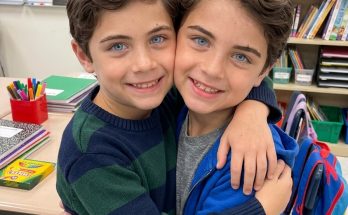
Summer brought long evenings and noisy sprinklers.
The boys started spending more time together.
At first, their visits followed a careful schedule made with help from the counselor and attorneys.
Then the schedule became easier to live inside.
Tuesday afternoons.
Some Saturdays.
A shared trip to the swimming pool when both boys wanted it.
Nina and I still checked before changing anything.
I kept a small notebook of Stefan's preferences.
He disliked the feel of wet socks.
He loved mango ice pops.
He had a habit of tapping a pencil twice before beginning a drawing.
I did not copy the notebook from a parenting guide.
I learned these things by spending time with him.
One afternoon, the boys built a blanket fort in the living room.
They argued about where the entrance should go.
Cole wanted it behind the couch.
Stefan insisted the kitchen side was more defensible.
They made a paper sign that said NO ADULTS WITHOUT PERMISSION.
I knocked on the sofa cushion.
“May I deliver snacks?”
A small hand appeared through the blanket.
“Leave them outside.”
I set the crackers down.
Through the cloth I heard the boys whispering and laughing.
I stood there longer than I needed to.
They were finally allowed to be children together.
I was also meeting with a divorce attorney.
That decision had not come suddenly.
Mark and I had shared a home for more than a decade.
There were bills, savings, retirement accounts, and a mortgage.
We had a son in one household and another child whose legal arrangements were still being determined.
We could not separate our lives with one angry conversation.
I brought folders to the attorney's office.
Bank statements.
Property documents.
Insurance information.
Records of expenses for Cole.
I asked about temporary financial arrangements, property division, and parenting plans.
The attorney explained the process and the likely need for negotiations.
I knew it would take time.
When I told Mark I intended to file, he closed his eyes.
“Is there nothing I can do?”
“There are things you can do for the boys.”
“I mean for us.”
I thought about telling him that he had destroyed us years earlier.
But that felt too simple.
Our marriage had continued through breakfasts, family trips, holidays, and ordinary moments.
I had loved him during those years.
The fact that he lied did not turn every memory into a performance.
It did mean I no longer trusted the person beside me in those memories.
“I cannot stay married to someone who let me bury a child in my imagination while that child was alive,” I said.
He covered his face.
“I know.”
“Then don't ask me to prove it hurts enough.”
He nodded.
We sat in silence.
After that, our conversations stayed focused on schedules and finances.
He began contributing to the boys' expenses according to temporary arrangements while broader legal issues were reviewed.
I did not pretend he could purchase forgiveness.
I also did not refuse support that was properly owed to the children.
Stefan was curious about my life before he knew me.
He asked what my job was.
I told him I worked as an office manager for a small architecture firm.
He asked whether I had helped design our house.
“No. But I once argued with the architect about where to put the storage cabinets.”
“Did you win?”
“Some of them.”
He smiled.
Then he asked if I liked drawing.
“Not as much as you.”
He held out a pencil.
“Try.”
We drew houses on graph paper.
His had a rooftop garden and a slide into a swimming pool.
Mine had too many windows.
He laughed at my crooked roof.
I laughed too.
The next weekend, Cole complained that Stefan got more attention.
I listened without defending myself.
“Sometimes I worry about him because everything is new,” I admitted.
“That doesn't mean you're less important.”
Cole kicked the leg of the kitchen chair gently.
“Everyone asks about Stefan.”
“That's a lot for you.”
“Even Grandma.”
I promised to talk with relatives about asking Cole about his own life, not only his brother.
Then I planned an afternoon just for us.
We visited the bookstore and ate noodles in his favorite place.
Cole chose a mystery novel and told me every detail of his latest school project.
I tried not to look at my phone.
I wanted him to feel that the family story still contained his whole life.
Our first summer outing without Nina nearby was to a public library and a small bakery across the street.
We planned it together with the counselor, and Nina remained reachable by phone.
Stefan chose the library because he wanted a book about bridges.
Cole chose it because the children's section had a game table.
We arrived just after opening.
Stefan asked for a library card.
The librarian explained which identification and caregiver authorization were required.
I had brought the documents available under our current arrangements, but one form still needed Nina's signature.
We took it home rather than arguing at the desk.
Stefan looked disappointed.
I told him we'd get it sorted out properly.
He asked why grown-ups made so many rules about books.
I laughed.
“That's a very fair question.”
We borrowed a book on my card that day and asked Nina to help finish the application later.
At the bakery, both boys chose cinnamon rolls.
Cole ate the icing first.
Stefan carefully peeled his into layers.
I took a photograph of their hands beside the plates.
I didn't photograph their faces that time.
I wanted a picture of the little differences I was discovering.
On the way home, we passed a building site.
Stefan pressed his face to the car window.
He asked why the workers were putting metal rods inside the concrete.
I explained as much as I knew from my job.
He asked more questions.
When I admitted I didn't know one answer, he said we should ask an engineer.
A week later, one of my coworkers agreed to show the boys a model of a bridge at the office.
We arranged a short visit during a quiet afternoon.
Cole became interested in the model's moving parts.
Stefan wanted to know who decided how much weight it could carry.
My coworker explained basic engineering concepts in language they could understand.
Both boys left with graph paper and small rulers.
That evening, they built a paper bridge across two kitchen chairs.
It collapsed under a stack of books.
They argued about the supports.
Then they rebuilt it.
The second bridge lasted longer.
I thought about how different their first attempts at knowing one another had been.
Back then, every question sounded like a threat.
Now they could argue about cardboard and pencils without wondering whether the other boy was trying to steal his place.
After Stefan went home, Cole asked whether he could invite a school friend over next weekend instead.
“Of course,” I said.
He looked uncertain.
“Will Stefan think I'm mean?”
“Having your own friends isn't mean.”
“Okay.”
I asked whether he'd like me to explain it to Stefan.
He said he could tell him himself.
I let him.
The next day, Cole sent a message through our agreed family chat saying he had plans on Saturday.
Stefan replied with a picture of his soccer practice schedule.
Neither acted as though the friendship was ending.
I was proud of them for that.
The following month, we had our first disagreement about a missed visit.
A school activity ran late, and I had not seen the updated timetable.
Nina thought I had canceled without telling her.
I thought she had changed the pickup plan.
For ten minutes, our phone call sounded like the first day in the principal's office.
Then we stopped.
We checked the written schedule.
The change had been sent to an old email address.
Neither of us had intended to shut the other out.
We updated our contact details and agreed on a confirmation message for future changes.
When Stefan asked what happened, we told him there had been a scheduling mistake and we had fixed it.
We did not tell him one adult cared more than the other.
He shrugged.
“Can we still go to the pool?”
“Yes,” I said.
We went the following weekend.
He spent most of the visit trying to improve his kick turns.
Cole insisted he was faster.
They raced across the shallow end under the lifeguard's supervision.
Both claimed victory.
I bought them snacks afterward and refused to act as the official judge.
On the drive home, Stefan fell asleep against his seatbelt.
Cole put a folded sweatshirt under his brother's head without being asked.
I looked at them in the mirror and returned my eyes to the road.
I wanted them to have more moments like that, unrecorded and unannounced.
Dr. Shaw later asked how the sleepover had gone.
I told her Stefan had called Nina and chosen to stay.
“Would you have let him leave?” she asked.
“Yes.”
“Even if you were disappointed?”
“Especially then.”
She nodded.
I wanted both boys to understand that love did not require them to manage my feelings.
They could choose a visit, ask for space, or change their minds without losing their place in my life.
At the end of August, Stefan asked to sleep over.
I did not say yes immediately.
We discussed it with Nina, the counselor, and the adults managing the court plan.
We made a short first visit, with Nina available and Stefan able to leave if he wanted.
He packed Copper, the knitted fox.
He also brought a small flashlight.
The boys slept in separate beds in Cole's room.
They whispered long after lights-out.
At eleven, Stefan came into the hallway.
“Can I call Nina?”
“Of course.”
I sat nearby while he talked to her privately.
When he finished, he looked embarrassed.
“You don't have to be embarrassed,” I said.
“Missing her is normal.”
He thought about going home.
Then he decided to stay.
At breakfast he poured cereal for himself and Cole.
He used too much milk.
Cole laughed.
Stefan laughed back.
I stood at the counter making toast.
There was no music swelling in the background.
No perfect speech.
Just two bowls, a spilled spoonful of milk, and a Saturday beginning in a way it should have been able to begin years earlier.
Click here to continue reading: PART 11: The Final Orders Gave Stefan More Than One Home Without Asking Him to Choose Whom to Love
The Boy in the Principal’s Office Had My Son’s Eyes and My Lost Baby’s Birthmark
Part 10 of 12