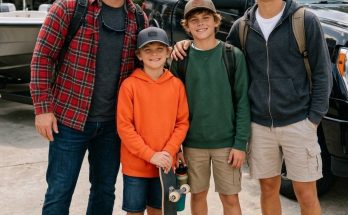
I used to believe the worst moment of my life was the morning a police officer told me he couldn't find my husband or our sons.
For six years, I measured every difficult day against that one.
Then Sophie carried a dusty cellphone into my kitchen.
And I learned that grief could change shape.
Daniel and I had six children.
Three boys.
Three girls.
Our household was rarely quiet.
There were backpacks on the stairs, muddy shoes beside the back door, and arguments over whose turn it was to wash the dinner plates.
Daniel loved that noise.
He said silence was overrated.
Every summer, he took our sons fishing for the weekend.
I stayed home with the girls.
It wasn't a rule about boys and girls.
Our daughters were welcome to go, and occasionally they did.
But the boys had made that trip their own tradition, something they discussed for weeks beforehand.
That last Friday, the driveway smelled of wet grass and gasoline.
Our oldest son, Owen, kept telling his younger brothers, Caleb and Noah, that he deserved the front seat.
Caleb said age didn't make him special.
Noah said whoever carried the bait should get to choose.
Daniel laughed so hard he had to lean against the truck.
I brought out sandwiches wrapped in wax paper.
He kissed my cheek.
"We'll be back Sunday before supper."
"You always say that."
"And I'm usually only a little late."
I made the four of them stand together for a picture.
Owen tried to look grown-up.
Caleb crossed his eyes.
Noah clutched the blue tackle box Daniel had given him for his birthday.
Daniel rested a hand on each of the older boys' shoulders.
The photograph is still on my refrigerator.
The corners have curled.
I have never managed to replace it.
On Sunday evening, I set four extra plates on the table.
At eight, I covered the food.
At nine, I tried Daniel's number again.
It rang until voicemail.
Owen's phone did the same.
Caleb and Noah didn't yet have phones.
By midnight, I had called the police.
The next morning, officers found Daniel's truck beside the boat ramp.
The trailer was attached.
The boat was gone.
Later that day, a search team found the boat damaged along the opposite shore.
No one was inside.
They searched for weeks.
Boats traced the shoreline.
Divers worked the coves.
Helicopters passed overhead.
Neighbors walked through wet brush calling names they knew no one would answer.
Nothing came back.
Investigators said an accident was the most likely explanation.
There had been unstable weather on the lake that weekend.
Currents could move bodies into places where search crews couldn't reach them.
Without bodies, there were limits to what anyone could prove.
I understood their words.
I never found peace in them.
Daniel checked forecasts compulsively.
He always carried extra fuel, an emergency radio, and life jackets that fit each child.
He had fished that lake for three years.
I couldn't reconcile that careful man with the story I had been given.
His younger brother, Dean, urged me to stop questioning it.
"You need to move on," he said.
He said it gently at first.
Later, he said it with irritation.
Dean became part of our daily life after the disappearance.
He fixed the basement steps.
The old photograph held details I'd never noticed until we began looking at it as evidence.
Daniel had tied a red ribbon around the handle of the blue tackle box so Noah could recognize it among the others.
Owen had a patch sewn onto his jacket from the summer baseball league.
Caleb had tucked a fishing lure into his shirt pocket, even though Daniel had told him not to carry hooks without a cover.
And there was the corner of the yellow waterproof case, visible beside the cooler.
At the time, I was more concerned with whether everyone was smiling.
I had told Daniel to step away from the truck so the sun wouldn't shine directly behind his head.
He complained that I took too many photographs.
"One day you'll be grateful," I'd told him.
He wrapped his arms around the boys and said, "All right, boys. Let your mother have her masterpiece."
They laughed, and I pressed the button.
A small, ordinary family memory.
It never occurred to me that a single image could become the last complete record of their lives together.
After the disappearance, people tried to help in different ways.
Our neighbor Mrs. Wilkes brought casseroles until the freezer was full.
The boys' teachers sent drawings their classmates had made.
Daniel's contractor friends organized a fundraiser when I had to cut my hours at work.
Some people spoke too much.
Some avoided us because they couldn't think of what to say.
A few disappeared altogether.
I learned that grief made other people uncomfortable, but it also made me less patient with easy answers.
When someone said the boys were in a better place, I wanted to ask how they could know.
When someone said I would eventually feel closure, I wondered what closure could possibly mean when four people had vanished without a grave.
I wasn't ungrateful.
I just needed room for the uncertainty that existed.
There were practical problems nobody warned me about.
A bank account in Daniel's name couldn't simply be closed because I showed the teller the newspaper article.
Insurance questions required documents and legal determinations.
Some bills kept arriving.
We had to sort through property records while our daughters still needed lunches packed for school.
I made lists because lists were the only things I could control.
Milk.
Laundry detergent.
Permission slips.
Call the insurer.
Ask the lawyer about the partnership.
At night, I sometimes found myself making a seventh lunch before remembering that Owen wasn't there to take it.
Once I stood in the grocery store holding Caleb's favorite cereal and couldn't decide whether to put it back.
I bought it.
The girls ate it because they didn't want to see me cry.
Years later, I apologized for the ways I'd leaned on them without realizing it.
Sophie told me she didn't blame me.
But she admitted she had spent years trying to be the child who never caused trouble.
That hurt.
I told her she was allowed to be difficult, uncertain, and young.
I told her she could fail a test, argue about curfew, or ask for help without worrying that it would break me.
She cried then, and so did I.
The discovery of the phone didn't erase those years.
Whatever its recording revealed, we still had to live with everything that had happened between the missing Sunday and that Thursday in our kitchen.
I had never thought of those boys as a collection of lost belongings. Each one had his own stubborn habits, favorite jokes, and ways of asking for comfort. I tried to hold onto that whenever someone referred to them only as missing persons. They were Owen, Caleb, and Noah. They had been ours long before the lake became part of their story. I wanted the girls to know that distinction too.
He drove our daughters to appointments when I could hardly leave the house.
He brought groceries when money was tight.
I was grateful.
I also learned to stop asking questions when he was present.
The girls grew around the empty places.
Sophie, our eldest daughter, learned to drive.
Our middle daughter, Emma, began playing the cello.
The youngest, Lily, stopped asking when Daddy would come home and began asking questions about what drowning meant.
I answered as carefully as I could.
I never told her certainty was something I possessed.
Six years passed.
That autumn, Sophie said we should sort through the boxes in the storage room.
"Not throw everything out," she explained.
"Just decide what we need to keep."
I thought about Daniel's coats.
About Owen's school jacket.
About the fishing equipment that still smelled faintly of lake water.
"Maybe a few things," I said.
We spent the afternoon opening drawers.
Sophie folded clean shirts into donation bags for our church.
Emma took photographs of the things we weren't ready to part with.
Lily sat on the floor making a small pile of objects she wanted to save.
A yellow whistle.
A baseball glove.
A little wooden fish Noah had carved.
I went to the kitchen to prepare dinner.
Then Sophie appeared in the doorway.
She was holding a cellphone.
It was an old model with a cracked case.
I recognized it immediately.
Years before the trip, Daniel had said he'd lost that phone.
We bought him another one.
I never knew where the original had gone.
"Where did you find that?" I asked.
"Inside Dad's winter coat."
"It wasn't there before."
"It was in a lining pocket. Somebody had stitched the opening closed."
Sophie looked frightened.
"The phone still had some charge when I plugged it in. I tried his old PIN."
I remembered the number.
The date of our wedding.
"It opened," she said.
She turned the screen toward me.
A video sat near the end of the gallery.
The date was the Thursday before Daniel and the boys disappeared.
One day before their trip.
"Mom, I think I finally know what happened."
She pressed play.
At first, the screen showed a dark room.
Then Daniel's voice sounded close to the microphone.
"Say it again, Dean."
I gripped the edge of the counter.
A chair scraped.
A second voice answered.
"I said I can handle the boat. You don't have to come."
Dean.
Six years of dinners, repairs, and comforting words flashed through my mind.
I looked at Sophie.
She looked as though she'd been holding her breath for a long time.
The recording continued.
Daniel said, "You forged my name on that transfer. And now you're asking me to trust you with the boys?"
A heavy silence followed.
Then Dean said something I couldn't forget.
"You don't understand what happens if people find out."
The video ended abruptly.
I couldn't move.
Neither could Sophie.
Outside, a car door closed in our driveway.
We heard the familiar rattle of keys.
Dean had arrived for his usual Thursday dinner.
For the first time in six years, I didn't want him inside my home.
Click here to continue reading: PART 2: The dinner Dean expected and the first question we were finally brave enough to ask
The photograph from the driveway and the recording Sophie found six years after the lake
Part 1 of 12