It took several days for the technicians to examine the object.
The water had damaged it badly.
The battery compartment was corroded.
Its outer markings were difficult to read.
But beneath the casing, an identifying number remained legible.
It matched the number on Daniel's warranty card.
I sat on the edge of my bed when the detective told me.
I pressed a hand against my chest.
"So he was there."
"The radio was there," she said carefully.
"We still need to determine how it reached that location."
I knew she was being precise.
Part of me resented the precision.
Another part knew it was the reason I trusted her.
The team returned to the inlet.
They examined the surrounding area with equipment better suited to water and submerged debris than the tools available during the original search.
They found fragments of plastic, fishing line, and pieces of metal.
Most could not be tied to any specific boat.
One piece of rail fitting resembled equipment used on Daniel's vessel.
An examiner would need to compare it with photographs and manufacturer information.
Nothing could be claimed yet.
I told Sophie about the radio after she returned from work.
She looked at me without speaking.
Then she asked whether the discovery meant Daniel had reached the inlet alive.
"We don't know."
"It had to get there somehow."
"Yes."
"I hate that answer."
"I do too."
We went for a walk.
The sidewalks were damp from a morning shower.
Sophie told me she had been dreaming about Owen lately.
In the dream, he was waiting outside their old school.
She knew she had to tell him something but couldn't remember what.
"I think I'm angry at him for leaving," she said.
"Then I feel guilty."
"You can be angry that someone is gone without blaming them for going."
She nodded, though I could tell the words didn't solve anything.
We bought bread at a corner bakery.
We returned home without discussing the case again.
That small walk helped more than another hour of speculation.
The financial investigation continued separately.
Detectives obtained records showing that Dean had authorized withdrawals from the storage business in the months before the disappearance.
The account had been used to cover personal debts.
They also found paperwork bearing Daniel's purported signature.
A document examiner compared the signature with known samples.
The recovered radio brought a new kind of attention to our family.
People in town began discussing the disappearance again.
Some meant well.
They asked whether there was news whenever they saw us at the grocery store.
Others repeated rumors they had heard without checking them.
One woman stopped me near the library checkout desk and said she had always suspected something sinister.
I asked her not to discuss my family with me while I was working.
She looked offended.
I felt guilty for a moment.
Then I reminded myself that my daughters' lives were not public entertainment.
At school, Lily heard another child say her father might have run away on purpose.
She came home furious.
"That's not true," she said.
I hugged her.
"People say things when they don't have facts."
"Can you tell everyone?"
"I can tell your teachers we need help stopping rumors. I can't control every person."
I contacted the school counselor.
We discussed a plan for handling comments without making Lily explain her family's history to classmates.
Her teacher checked in discreetly.
I was grateful she didn't turn Lily into the subject of a classroom lesson.
Emma faced a different problem.
During orchestra rehearsal, she became upset when someone played a melody that reminded her of the memorial service we'd held years earlier.
She stepped outside.
Her conductor asked whether she wanted to return that day.
She did.
Later, she told me she hated being treated as fragile.
"I want to be able to have a bad moment without everyone deciding I'm falling apart."
"Then we'll tell people what helps."
We practiced saying, "I need a minute. I'll be back."
Sophie was preparing to leave for college when the new evidence emerged.
She worried that moving away would be selfish.
I told her I wanted her to go.
"You found the phone. You told the truth. You are not responsible for solving the case."
"But what if something happens while I'm gone?"
"I'll call you. And we will handle it together."
She looked unconvinced.
We talked to the counselor about the guilt she felt whenever she imagined doing something joyful.
The counselor asked her what Daniel would have wanted for his daughters.
Sophie said he would have wanted her to study engineering.
He had always shown her how to fix things.
She laughed when she remembered him handing her a screwdriver at age eight.
"He said I was better at reading instructions than he was."
We found an old photograph of her crouched beside a broken fan while Daniel watched proudly.
She put it in a frame for her dorm room.
The detective called while we were sorting her school supplies.
She explained that the recovered radio could support the revised geographic search but might never reveal whether it had been used during the incident.
I thanked her.
Afterward, I returned to the list of things Sophie needed.
Sheets.
Towels.
A desk lamp.
A sturdy laundry basket.
Those ordinary purchases felt almost defiant.
The person who had hidden the truth had already taken too much from our family.
I didn't want his decisions to take Sophie's future as well.
That night, I found Lily studying the photograph on the refrigerator.
"Will we ever know everything?" she asked.
"Probably not everything."
"Then how do we stop being sad?"
I sat beside her.
"We may be sad sometimes for the rest of our lives. But sadness doesn't have to be the only thing we feel."
She considered that.
Then she asked if we could make popcorn and watch a comedy.
We did.
For ninety minutes, the four of us laughed together.
The examiner could not determine every disputed mark with certainty.
But some were inconsistent with Daniel's normal writing.
The investigators considered whether the evidence supported forgery or fraud charges.
I learned about the general findings after the detective consulted with prosecutors.
No one promised that the financial case would explain the boating incident.
Then the mechanic identified one more record.
His former shop had ordered a replacement bow fitting for the second boat after the disappearance.
The fitting's measurements were documented.
Specialists compared those dimensions with marks visible on the photographs of Daniel's damaged boat.
The patterns were consistent with a possible collision.
They could not conclusively match one vessel to the other from those records alone.
Still, the findings gave investigators reason to examine the second boat's history more closely.
That boat had been sold years earlier.
Its current owner cooperated.
Investigators documented repairs, replaced sections, and remaining structural features.
It wasn't a television drama.
Nobody uncovered a perfect dent that solved the case in seconds.
They collected measurements, photographed surfaces, and sent materials to specialists.
Weeks passed.
I returned to work part-time at the library, where I had taken a position after Daniel vanished.
My supervisor gave me flexibility for appointments.
I tried not to spend every break checking my phone.
The witness who remembered the service station couldn't give us the certainty I wanted.
He hadn't written down the encounter at the time.
He hadn't known there was anything important about the men beside the trailer.
His memory was six years old.
The detective explained that interviewers had taken care not to suggest details he hadn't volunteered.
They had asked him to describe what he recalled in his own words.
They compared those details with records that existed independently.
That process mattered because memory could feel convincing even when it was mistaken.
I thought about my own recollections of the last Friday.
Had Daniel said he would be back before supper or by supper?
Had the boys argued about the front seat before or after I packed the sandwiches?
I could no longer swear to every small detail.
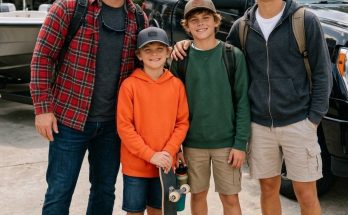
But I remembered the way Daniel had smiled when he called the boys over for the photograph.
I remembered the smell of wet grass.
I remembered the blue tackle box.
Some memories were emotional.
Others could be checked against evidence.
I was learning not to confuse the two.
One evening, I told Margaret how frightened I'd become of misremembering something important.
"You don't need to become a witness who knows everything," she said.
"You need to be truthful about what you do and don't know."
I wrote that down in my journal.
The next time Detective Whitcomb asked a question I couldn't answer, I simply said so.
She thanked me.
It was oddly relieving.
I didn't have to fill every silence with a theory.
Emma auditioned for a youth orchestra.
Lily joined a school science club.
Sophie submitted college applications.
Life kept happening around the investigation.
One afternoon, a reporter called my home number.
She said she had heard the old disappearance was being examined again.
She wanted a statement.
I declined.
I didn't want my daughters' grief turned into a mystery for strangers to argue over.
Later, I told the girls they were allowed to refuse interviews.
They didn't owe anyone their fear or their memories.
The next significant call came on a Monday morning.
Detective Whitcomb asked me to come to the station.
A witness had provided new information.
The witness had worked nights at a service station near the storage yard.
He remembered seeing two men in a heated discussion beside a boat trailer on the Friday evening of the trip.
One man matched Dean's description.
The witness could not confidently identify the other.
He remembered because the men had argued loudly enough to make him consider calling his manager.
"Does he remember the boys?" I asked.
The detective hesitated.
"He remembers hearing children speaking from a nearby vehicle. He cannot say whose children they were."
I felt my hands turn cold.
It was the first time anyone had placed children near the unexplained second boat.
And it raised a question I had avoided for six years.
Had my sons been frightened before they disappeared?
Click here to continue reading: PART 9: Dean’s account changed, and the investigators finally explained why they believed he had been on the water
The photograph from the driveway and the recording Sophie found six years after the lake
Part 8 of 12