The underwater search began in early spring.
The lake was still cold.
The team worked with careful procedures and specialist equipment.
I wasn't allowed at the site.
I was relieved and disappointed at the same time.
My lawyer urged me not to spend the day watching news alerts.
I tried.
I went to the library.
I shelved returned books.
I helped a child find a story about foxes.
Then I sat in the staff room and stared at the wall.
By the time the detective called, my hands were shaking.
The team had located additional wreckage on the lakebed.
Some pieces were consistent with the missing sections of Daniel's boat.
The debris lay in the area Dean had described after finally admitting the collision.
It would take examination to determine exactly what belonged to which vessel.
The team also recovered personal effects.
A damaged tackle box.
A metal clasp.
Fragments of clothing.
The detective warned that none of those items alone established what happened to the four missing people.
I understood.
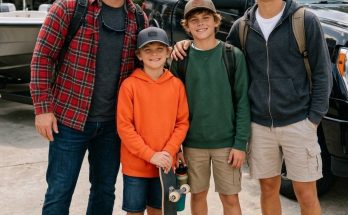
Then she asked me to describe the blue tackle box Noah had carried in our last photograph.
I told her about the bent latch.
About the sticker he'd attached upside down.
About the scratch shaped like a crescent near one corner.
She asked me to come in and look at photographs under controlled conditions.
Margaret drove me.
On the screen was the box.
The sticker was nearly gone.
The bent latch remained.
I recognized the scratch.
I had to leave the room.
For a long time, Margaret sat with me in the hallway.
I cried until I couldn't speak.
It was the first physical object from the trip that had come back to us.
The investigators eventually confirmed that the box was consistent with Noah's belongings.
They couldn't say precisely how it reached the bottom.
They did not find the boys or Daniel during that search.
That absence was its own kind of pain.
But the location supported the investigators' revised understanding of the accident.
Prosecutors later filed charges against Dean related to the financial transfers and his conduct following the collision.
The exact counts were explained to us in a meeting.
Some allegations were more strongly supported than others.
The prosecutor emphasized that Dean remained entitled to legal representation and due process.
The first court appearance was nothing like the scenes I'd seen on television.
There was no dramatic confession from the witness stand.
There were procedural questions, schedules, and lawyers speaking in careful terms.
I sat behind the prosecutor beside Margaret.
Dean looked older than I remembered.
He didn't turn toward me.
I was relieved.
Part of me had wanted him to see what he'd done to us.
Another part couldn't bear the thought of meeting his eyes.
Afterward, the prosecutor spoke to our family privately.
She explained which charges had been filed and which issues would need more work.
I asked whether she believed the evidence would be enough.
She said that was what the legal process would test.
I respected the answer even though it left me unsettled.
The girls didn't attend every hearing.
We made those decisions with their wishes, their ages, and professional advice in mind.
Sophie attended one proceeding with me.
Emma chose to stay at school.
Lily wanted updates afterward but didn't want to enter the courtroom.
I told them all three choices were reasonable.
Nobody had to demonstrate love for their father and brothers by sitting in a room with Dean.
The partnership case brought another wave of paperwork.
There were questions about old withdrawals, management authority, and what could be documented after so much time had passed.
My lawyer explained that a criminal financial charge and a civil effort to recover money were different matters.
A guilty plea didn't automatically put missing funds back in our account.
We had to make decisions about legal expense, potential recovery, and the emotional cost of continuing.
I reviewed those decisions with an accountant and my lawyer.
They didn't ask me to make them in one afternoon.
I appreciated the time.
At home, Sophie helped label archive boxes.
I made sure she understood that I wasn't asking her to become the family's bookkeeper.
"I just need help keeping the papers in order this weekend," I said.
She grinned.
"I like putting labels on things."
We spent an hour sorting copies from originals.
Then we closed the boxes and went outside.
Emma had invited two friends over for music practice.
The living room filled with notes and laughter.
Lily and Margaret baked bread.
For a few hours, our home sounded like a house where children lived, not a place waiting for the next call from a detective.
The hearing on Dean's plea came later.
He acknowledged certain conduct under questioning by the court.
The judge made sure he understood the rights he was giving up and the consequences of the agreement.
I listened carefully.
There were statements I wished he had made more plainly.
There were things I would never hear him say.
But I understood that a court record was not a substitute for every answer a family wanted.
The judge did not promise to resolve our grief.
He addressed the offenses before the court.
At sentencing, I carried my statement on two sheets of paper.
My hands shook so badly the pages rattled.
I began by describing Daniel and the boys as people.
Then I described the years of searching, waiting, and telling the girls we didn't know.
I spoke of Dean's repeated instruction to move on while he withheld information that could have guided a search.
I finished by saying that his silence was not a small mistake made in one frightened moment.
It had continued through every day that followed.
When I sat down, Margaret squeezed my arm.
I felt exhausted.
I also felt that, for once, no one had interrupted me or told me to stop asking questions.
I was angry enough to want certainty immediately.
I also knew the case had to survive scrutiny in court.
The financial records showed unauthorized use of partnership funds.
Several documents had signatures that investigators believed were not Daniel's.
The boating evidence included Dean's changing statements, the second vessel's repair history, witness accounts, and physical findings.
Those pieces did not erase the need to prove specific offenses.
There were hearings.
There were motions.
There were months when I heard very little.
Reporters sometimes called.
I declined most interviews.
Once, I issued a short statement through my lawyer asking people to respect the girls' privacy.
I didn't want strangers deciding what Owen, Caleb, and Noah had felt in their final moments.
I didn't know those answers.
I wouldn't invent them for an audience.
Sophie began college within driving distance.
Emma continued with music.
Lily started keeping a small journal of memories about her brothers.
She wrote that Noah used to steal the last cookie and then leave her half.
She wrote that Caleb taught her how to skip stones.
Before the sentencing hearing, the victim-support coordinator asked whether I wanted help preparing my statement.
I accepted.
She explained that I could describe the impact of the offenses on our family without trying to predict what sentence the judge would impose.
I wrote several drafts.
The first was mostly anger.
The second was full of memories I could barely read aloud.
The third was shorter and clearer.
I began with Daniel's name.
Then Owen's.
Then Caleb's.
Then Noah's.
I wrote about the Sunday supper that grew cold.
The weeks of searching.
The six years of telling our girls that an accident was likely but not fully explained.
I wrote about Dean helping us while concealing his own involvement.
I couldn't understand how he had done both.
I didn't need to understand his private thoughts to describe the damage.
The coordinator reminded me to bring water and a printed copy.
She said I could ask for a pause if my voice failed.
At home, Sophie offered to read the statement for me.
I thanked her.
Then I said I wanted to try myself.
"You don't have to do it alone," she said.
"I won't be alone. You'll be sitting there."
We hugged.
On the morning of sentencing, I wore a simple blue dress Daniel had liked.
I carried his photograph in my purse.
I didn't show it to the judge.
I just wanted it nearby.
Afterward, when everyone asked how I felt, I didn't know what to say.
I was relieved that a legal process had reached a result.
I was sad that it couldn't answer every question.
I was grateful that the girls had people supporting them.
All those feelings existed at once.
I carried the folded statement home in my bag.
She wrote that Owen had once walked home in the rain to bring her a forgotten lunch.
Those were the things I wanted her to remember.
Not just a case number.
As the months passed, Dean's attorney and prosecutors discussed a possible resolution.
I was consulted about the impact on our family.
I could express my views but did not control the decision.
Dean eventually entered guilty pleas to several charges, including financial wrongdoing and a charge arising from his failure to report the collision and seek aid.
Other allegations were resolved or dismissed under the agreement.
The court reviewed the plea before accepting it.
At sentencing, I read a statement.
I said I did not know whether an immediate call would have saved my husband and sons.
I would never know.
But Dean had taken from us the chance to have rescuers respond with accurate information while time still mattered.
That choice had wounded our family for six years.
I didn't shout.
I didn't demand revenge.
I told the judge what his silence had cost.
The judge imposed a sentence under the applicable law and ordered restitution connected to the proven financial losses.
The civil and partnership issues still required separate work.
A court judgment could not return my family.
But the record no longer called their disappearance an unexplained boating mishap.
When we left the courthouse, Sophie asked whether I felt better.
"Somewhat," I said.
"And terrible."
She squeezed my hand.
"Both can be true."
Click here to continue reading: PART 12: Six years of silence ended with honest answers, unfinished grief, and a new promise to my daughters
The photograph from the driveway and the recording Sophie found six years after the lake
Part 11 of 12